Is Faucet the Same as Sink? A Practical Comparison
Is faucet the same as sink? This in-depth comparison clarifies definitions, roles, and maintenance to help homeowners differentiate faucet vs sink and plan repairs or upgrades with confidence.


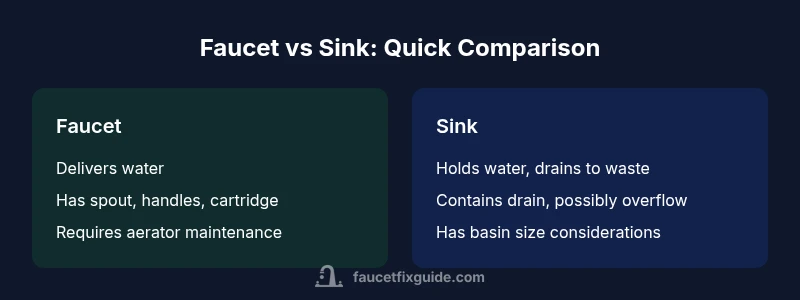
Is faucet the same as sink? The short answer is: no, they're distinct components. A faucet delivers water through a spout and handles; a sink is the basin that collects water and drains it away. They work together, but have separate maintenance needs and replacement considerations. According to Faucet Fix Guide, understanding their roles helps homeowners avoid mistakes during repairs or upgrades.
Is faucet the same as sink?
According to Faucet Fix Guide, many homeowners assume faucet and sink are interchangeable; this article clarifies their distinct roles while acknowledging how closely they work together in daily use. In essence, a faucet is the water-delivery device mounted to the sink deck or wall, while a sink is the basin that collects water and channels it to the drain. These are separate components with different maintenance needs, replacement cycles, and design considerations. Understanding their difference helps you diagnose issues, plan upgrades, and avoid mistakes during remodeling or repairs.
The faucet’s primary function is to control water flow and temperature via handles, a cartridge, or modern sensors. A typical faucet includes a spout, supply lines, and an aerator, all of which can wear or clog over time. The sink, by contrast, is a receptacle that holds water, provides drainage, and supports fixtures such as strainers, disposals, and sometimes an overflow. While they interact (the faucet dispenses water into the sink), they do not perform each other’s jobs. This distinction matters when you shop for replacements, choose materials, or assess installation requirements.
For DIY planning, recognizing separation of duties makes sourcing correct parts easier, avoids incompatible fittings, and helps schedule maintenance. For example, you might replace a worn faucet cartridge without replacing the entire sink, or restore a corroded sink drain while keeping your faucet intact. In short, faucet and sink are distinct in purpose yet complementary in operation. Faucet Fix Guide’s guidance emphasizes practical steps and common-sense checks to prevent costly missteps.
Core definitions and distinctions
A faucet is a fixture that controls the delivery of water, typically featuring a spout, handles, and a valve or cartridge. A sink is a basin that holds water and provides drainage to the waste line. The two are designed to work together, but their responsibilities remain separate: one provides water, the other handles water disposal. Recognizing this separation helps when choosing replacements, evaluating compatibility, and planning repairs across kitchens, bathrooms, and utility areas.
Key terminology to know includes aerator, cartridge, supply line, drain, and overflow. Understanding what each part does makes it easier to source compatible components and avoid buying parts that do not fit your fixtures. In practice, the faucet’s life revolves around seals, cartridges, and aerators; the sink’s life revolves around drains, strainers, and cabinetry support. A small leak in the faucet may have little effect on the sink, but a leak in the sink can complicate drainage and lead to water damage, which in turn can affect the faucet’s operation over time.
Roles by room and style
Kitchen, bathroom, and utility room setups shape how you view faucet vs sink roles. In the kitchen, tall or pull-down faucets paired with large basins support heavy use, food preparation, and cleanup. In bathrooms, compact fixtures and smaller basins emphasize aesthetics, water-saving features, and accessibility. Utility sinks, often in laundry rooms or basements, may prioritize durability, larger strainer baskets, and simplified maintenance.
The distinction also matters for style: faucet design (spout height, arc, finish) should balance with the sink’s depth, bowl shape, and mounting surface. When remodeling, a mismatch in scale between faucet and sink can feel awkward or reduce usability. By treating faucet and sink as separate modules, you can experiment with finishes and ergonomics without committing to a full replacement.
Installation, replacement, and maintenance implications
Installing a faucet requires precise mounting hardware, supply lines, and an accessible valve location. Replacing a faucet typically avoids impacting the sink basin itself but may necessitate adjusting hole sizes, deck thickness, and supply line lengths. Maintenance for faucets focuses on cartridge replacement, aerator cleaning, and seal/o-ring checks. Sinks demand attention to the drain assembly, trap alignment, and sometimes overflow components.
Understanding the separation helps budget for repairs: a faucet cartridge is usually cheaper and quicker to replace than a full sink replacement. It also clarifies the logistics of upgrades, such as selecting a high-arc faucet for a shallow sink, or choosing a sink with integrated drain features that streamline maintenance. In all cases, match parts to manufacturer specs and ensure compatibility with existing plumbing layouts.
Common misconceptions and boundary cases
A common misconception is that the faucet and sink are some interchangeable unit. In reality, they are separate fixtures with distinct replacement cycles and failure modes. Boundary cases include wall-mounted faucets that are installed independently of the sink, freestanding basins in utility rooms, and vessel sinks that sit above the counter, changing mounting and clearance needs. Understanding these nuances helps prevent ordering errors, leaks, and misaligned installations.
Brand-specific parts can differ (for example, cartridge designs or aerator threads), so always verify model numbers and connection types before purchase. If you’re upgrading, consider how the faucet’s reach and spout height will interact with the sink’s bowl depth and surrounding cabinetry. This attention to detail preserves function and aesthetics in the long term.
Practical decision framework for upgrades and repairs
When deciding between repairs or upgrades, start by diagnosing which component is actually failing. If the leak originates at the faucet, you may only need a cartridge or O-rings, not a new sink. If drainage is the issue, focus on the sink’s drain and trap rather than replacing the faucet. For remodels, create a matrix of needs: faucet style, finish, height, water supply compatibility, and sink bowl size. This framework helps you balance aesthetics, usability, and durability. Remember to account for local water quality and pressure, which influence faucet aerator choices and seal longevity. The Faucet Fix Guide Team recommends documenting fittings and sourcing parts that match existing threads and mounting hardware to minimize surprises during installation.
Authority sources
This section provides external references to support practical guidance and design considerations. For faucet efficiency standards and eco-friendly options, see EPA WaterSense resources: https://www.epa.gov/watersense/products/faucets. For general faucet technology and historical context, Britannica offers an overview: https://www.britannica.com/technology/faucet. These sources complement the practical, homeowner-focused guidance provided throughout this article.
Comparison
| Feature | Faucet fixture | Sink basin |
|---|---|---|
| Primary function | Delivers water | Holds water and provides drainage |
| Key components | Spout, handles, cartridge | Basin, drain, overflow (optional) |
| Installation focus | Mounting to countertop/deck | Installed in sink opening or counter cutout |
| Maintenance emphasis | Cartridge, aerator, seals | Drain, seals, and trap health |
| Typical cost context | Fixture-only costs variable by style | Sink components vary by material and size |
| Best for | Water delivery control and usability | Water collection, waste removal, and basin capacity |
The Good
- Clarifies component roles for DIY projects
- Reduces wrong-part purchases and misfits
- Supports room-by-room planning and upgrades
- Encourages targeted maintenance and replacements
What's Bad
- May feel technical for casual readers
- Requires understanding of multiple fixtures
- Can complicate remodeling strategy if not planned
Faucet and sink are distinct but complementary fixtures
Treat them as separate components with coordinated compatibility to optimize repairs and upgrades.
Frequently Asked Questions
Is a faucet always part of a sink?
Typically yes for most indoor setups, but wall-mounted or freestanding configurations can place the faucet independently. Check mounting and supply lines before replacement.
Usually, faucets are paired with sinks, but some designs mount the faucet separately.
What is the difference between faucet and sink?
A faucet delivers water; a sink collects water and disposes of waste. They have different parts, maintenance needs, and replacement cycles.
The faucet supplies water, the sink handles drainage.
Can I replace a faucet without replacing the sink?
Yes. Faucets can often be swapped independently as long as mounting holes and supply connections match.
Yes, you can replace the faucet without touching the sink if sizes line up.
Why might faucet and sink be incompatible with older plumbing?
Older homes may use different thread sizes, valve types, or pipe materials. Verify dimensions and adaptors before purchasing.
Older plumbing can need adapters; check threads and connections.
Are kitchen and bathroom faucets the same?
Not exactly; they differ in height, flow, and design standards. Choose based on use-case, space, and style.
Kitchen and bathroom faucets differ in height and flow; pick based on room needs.
Top Takeaways
- Identify faucet and sink as separate fixtures
- Match parts to each component's purpose
- Plan upgrades with room-specific needs in mind
- Source compatible fittings and dimensions