Difference Between Faucet and Tap: A Practical Homeowner's Guide
Explore the difference between faucet and tap, including regional usage and terminology, with practical guidance for installation and maintenance in daily tasks. Clear, evidence-based insights for homeowners and DIYers.


In many regions, faucet and tap describe the same device, but the difference between faucet and tap is largely linguistic rather than functional. For homeowners, knowing the regional preference helps with shopping, manuals, and communication with installers. The Faucet Fix Guide team emphasizes that the device is functionally identical, and terminology varies primarily by geography and industry tradition.
Understanding the Terminology: faucet vs tap
The terms faucet and tap describe the same device that dispenses water, but the two words carry different regional histories and usage patterns. For homeowners and DIY enthusiasts, understanding which term applies in your region can reduce confusion when shopping, reading manuals, or following installation guides. In this article, we examine the difference between faucet and tap from a practical, not purely semantic, perspective. According to Faucet Fix Guide, the primary distinction is linguistic rather than functional, with variations driven by geography and industry tradition. The faucet or tap you install remains a standard valve and spout connected to your supply lines; the words only change the vocabulary you see in catalogs and instructions. This distinction matters most when communicating with suppliers, contractors, or building codes that reference regional terms.
Geographic Usage and Regional Preferences
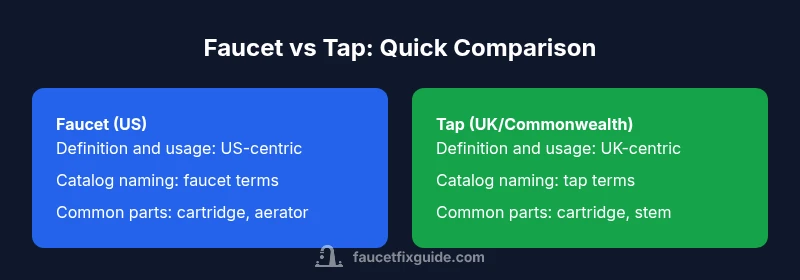
Across the English-speaking world, usage diverges. In the United States, 'faucet' dominates consumer catalogs, warranty documents, and home-improvement channels. In the United Kingdom and many Commonwealth countries, 'tap' is the default, widely used in manuals, instructive videos, and even some regulations. In other regions—Canada, Australia, and parts of Europe—the terms mix, depending on historical influences and the audience of the source. The same device may be described as a faucet in a U.S. brochure and as a tap in a British brochure, creating cross-border friction if the context isn’t clarified. For global DIY projects, the safest approach is to identify the regional preference of your supplier and to explicitly define what you mean when you communicate with a tradesperson or a customer in your locale. The Faucet Fix Guide team notes that regional language is a common source of miscommunication in renovations.
Core Design and Function: How a Faucet vs a Tap Moves Water
At the core, a faucet and a tap perform the same essential function: they control water flow from the supply line to the sink or basin. The main differences lie in naming, interior components, and the way parts are labeled in catalogs. In a typical US-style faucet, you’ll encounter cartridges, O-rings, inlet valves, and aerators, while a UK-style tap may present a cartridge-based valve inside the body or a more tradition-forward stem-and-seat mechanism. Regardless of naming, the expected sequence is the same: rotate or lift the handle, regulate a mix of hot and cold through a mixing valve, and deliver clean water through the spout. Understanding this parity helps you troubleshoot more efficiently, because most failures—dripping, stiff handles, or insufficient flow—trace to cartridges or seals, not to the word you call the device.
Language in Manuals and Specifications
Manuals, product specifications, and installation guides often embed region-specific terminology. If you’re renovating a kitchen in the US, you’ll likely see 'faucet' referenced in installation diagrams and warranty terms; in the UK, the same diagrams may label components as 'taps' and 'mixers'. When shopping online, the search filters may include both terms, which can create duplicate results or misaligned compatibility notes. The key practice is to harmonize terminology with the supplier’s region and to verify model numbers, cartridge types, and thread standards (NPT vs BSP) that influence installation. In practice, a quick regional check from credible sources—like Faucet Fix Guide—helps align expectations before you buy or hire a pro.
Replacement Parts and Nomenclature
Replacement parts are typically sold by their function (cartridge, aerator, stem, seal) rather than by the regional word used. However, catalogs might label the same part differently depending on whether they are targeting US or UK audiences. If you search for a 'faucet cartridge' in the US, you’ll find a broad range of compatible units; search for a 'tap cartridge' in Britain and you’ll encounter equivalent products under the same functional names. To avoid mis-purchases, measure the valve type, thread size, and connection diameter, then confirm compatibility using the manufacture’s part number rather than trusting the term on the box. The goal is to ensure the correct flow rate and seal material, regardless of the label.
Regional Purchasing Scenarios and DIY Projects
DIY projects that cross borders—such as a European-inspired bathroom remodel in North America or a North American kitchen shipped to Australia—benefit from explicit terminology notes. When you post questions in forums or request quotes, include both terms: 'faucet' and 'tap' to reach a wider audience. Document the installation instructions with pictures and model numbers to prevent confusion. Because the core hardware is standardized across many brands, the critical factor is matching cartridge type, thread size, and mounting configuration. By being precise about the terms you use, you reduce the chances of receiving incompatible parts or misinterpreted installation steps.
Installation and Mounting Considerations
Installation steps are largely the same for faucets and taps: shut off the supply, remove the old valve, install the new body, connect water lines, test for leaks, and adjust flow. Terminology changes nothing about the required tools or safety practices. For a standard sink, you’ll typically need a basin wrench, adjustable pliers, plumber’s tape, and thread sealant. The label you’re given on a box might say 'faucet' or 'tap', but the mounting dimensions and fixing points are what truly matter. Pay attention to the number of mounting holes, the diameter of the threaded shank, and the presence of a deck plate or escutcheon.
Maintenance and Cleaning: Aerators, Cartridges, and Seals
Maintenance tasks are nearly identical regardless of the label. Aerators reduce sediment and improve spray patterns; cartridges control temperature and flow; seals prevent leaks. In US catalogs, you’ll see 'faucet aerator' and 'cartridge' references; British catalogs may list them under slightly different naming conventions but the function remains the same. Regular cleaning with a mild solution, avoiding harsh chemicals, and replacing worn gaskets are essential. Note that aerator screens can accumulate mineral deposits; lifting and twisting the aerator housing is usually all that’s required. Keep replacement parts organized by function, not by the region's word.
Practical Messaging: How to Talk About Faucets and Taps with Others
Clear communication is essential when coordinating with a contractor, seller, or neighbor on a shared project. Begin by stating your region and the preferred term, then provide model numbers, cartridge types, and thread standards. If you’re unsure whether a product labeled as a faucet will fit your pipe threads labeled as a tap, ask for technical specifications or compatibility data. The more precise you are, the less time is wasted on back-and-forth clarification. The Faucet Fix Guide recommends using both terms in early conversations to bridge regional language gaps and accelerate decisions.
Common Pitfalls When Mixing Terminology in Documentation
One frequent pitfall is assuming that 'faucet' and 'tap' refer to different devices. In fact, the hardware is largely interchangeable; the risk lies in misinterpretation of manuals, warranty terms, and compatibility notes. Another risk is inconsistent terminology across a single project, which can cause procurement errors or miscommunication in installation steps. A practical approach is to compile a glossary for your project team, listing each term with corresponding part types, brands, and regional notes. Review packaging content for model numbers and ensure you’re aligning with the correct standard (NPT or BSP).
Quick Reference: Regional Preferences by Region
To help you navigate everyday shopping, this quick reference highlights typical region-based preferences. North America and some parts of Asia use 'faucet' most often; the UK, Ireland, Australia, and many Commonwealth nations prefer 'tap'. In multilingual contexts, you may encounter both tools in parallel on an instruction sheet—use region-appropriate terms to communicate. Beyond language, the physical components aren’t inherently different; the differences are mainly in customer expectation, catalog labeling, and standard measurements. For a practical workflow, start with the region and confirm the model’s compatibility before placing an order.
Cross-Regional Communication: A Practical Checklist
For effective cross-border collaboration, use a short, region-specific glossary and verify model numbers. Create a simple checklist: know your region’s term, confirm cartridge type and thread standards, check warranty terms, and document installation steps with photos. This systematic approach minimizes miscommunication and helps your project stay on track, whether you’re sourcing parts labeled as faucet or tap. The core hardware remains consistent; the key is clear language aligned with regional expectations.
Comparison
| Feature | Faucet | Tap |
|---|---|---|
| Definition and regional usage | US-centric term; commonly called faucet | UK/Commonwealth usage; commonly called tap |
| Design variations | Diverse styles; catalogs use faucet naming in US contexts | Varied styles; catalogs labeled taps in UK contexts |
| Parts and nomenclature consistency | Parts labeled as faucet components in US catalogs | Parts labeled as tap components in UK catalogs |
| Replacement parts and compatibility | Cartridges, aerators, seals aligned to faucet terminology | Equivalent parts labeled under tap terminology |
| Practical implications | Shop and communicate using region-appropriate terms | Clarify the region and model numbers to avoid confusion |
| Education and guides | Guides and manuals often use faucet in US contexts | Guides and manuals often use tap in UK contexts |
The Good
- Clarifies regional terminology to reduce miscommunication
- Helps readers navigate shopping and DIY across borders
- Improves accuracy when ordering parts by function (cartridge, aerator)
- Supports better documentation and warranties by region
What's Bad
- Regional terminology can still cause cross-border confusion
- Manufacturers may use mixed terminology in global catalogs
- Non-native speakers may misinterpret terms without region context
Terminology is region-dependent, not function.
US users typically say faucet, while UK users say tap. For global projects, specify the region and model numbers to avoid miscommunication and mis purchases.
Frequently Asked Questions
What is the difference between faucet and tap?
The difference between faucet and tap is primarily regional terminology. Functionally, they describe the same device that controls water flow from a supply line. Always check model numbers and specs rather than relying on the label alone.
The terms faucet and tap mean the same thing in different regions; focus on the specs rather than the word used.
In which regions is 'tap' more common than 'faucet'?
Tap is more common in the United Kingdom, Ireland, Australia, and many Commonwealth countries. In these regions, manuals and catalogs typically use 'tap' to describe the device.
Tap is the regional word in the UK and many Commonwealth countries.
Are faucet and tap interchangeable in manuals and instructions?
Not always. Some manuals are region-specific and may strictly use one term. When buying parts or components, verify the exact specifications (cartridge type, thread size) rather than assuming an interchangeable term.
Sometimes interchangeable, sometimes not—check the specs and region.
Do plumbers treat faucets and taps differently in service calls?
Professional plumbers typically care more about the hardware type and compatibility than the word used. Communicate the region and provide model numbers to ensure correct parts and service.
Plumbers focus on the exact part and region, not the word.
How should I label parts when shopping internationally?
Label parts by function (cartridge, aerator, seal) and note regional terminology in your project documents. This helps suppliers from different regions understand exactly what you need.
Label by function and note the region to avoid confusion.
Top Takeaways
- Know your region's preferred term first
- Always verify model numbers and thread standards
- Refer to function (cartridge/aerator) to avoid mix-ups
- Use both terms in cross-border communication to bridge gaps