How Often to Replace Faucet Cartridges: A Practical Guide
Learn how often to replace faucet cartridges, what affects lifespan, and a practical DIY guide to keep faucets drip-free and efficient.


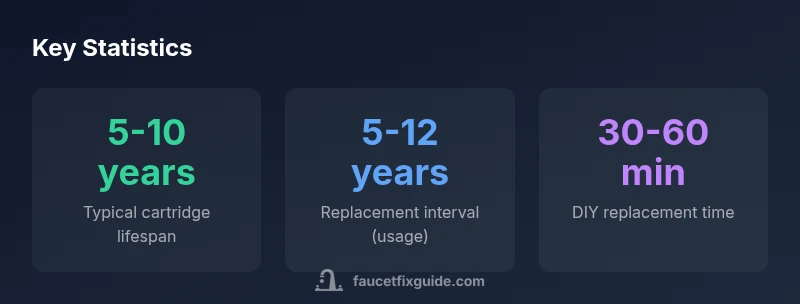
How often should you replace a faucet cartridge? Most residential faucets with standard cartridges perform best when replaced every 5-10 years, depending on water quality and usage. If you notice leaks, stiff handles, or reduced water flow, inspect and replace sooner. Regular maintenance and proper installation can extend cartridge life and preserve faucet performance.
What is a faucet cartridge and why replacement matters
A faucet cartridge is the replaceable valve inside most modern single-handle faucets. It regulates water flow and temperature, and its seals prevent leaks. Over time, cartridges wear from mineral buildup, corrosion, and frequent use. How often replace faucet cartridge isn’t a fixed rule; it depends on usage and water quality, but a practical guideline is every 5-10 years for typical homes. According to Faucet Fix Guide analysis, wear patterns vary by faucet model and local water conditions, so owners should monitor for signs of wear rather than sticking to a calendar alone. When a cartridge wears out, you’ll often notice leaks around the base, a persistent drip after shutting the faucet, or stiff/ticky-sounding handles. Replacing a cartridge restores smooth operation, reduces wasting water, and prevents damage to other valve components. In this section, we break down what cartridge assemblies do, why they fail, and how homeowners can approach a replacement with confidence.
Understanding the cartridge’s role helps explain why replacement timing matters. The cartridge sits where the water supply lines meet the faucet body; it contains seals that prevent leaks between hot and cold sides. Scale buildup from hard water can seize internal parts, while worn O-rings can cause slow leaks. A practical replacement mindset blends observation (signs of wear) with a maintenance schedule based on your water quality and usage. This combination reduces the risk of unexpected leaks and helps your faucet perform as designed for longer.
Factors that influence replacement frequency
Several interacting factors determine how often you should replace faucet cartridges. Hard water with high mineral content accelerates mineral buildup on internal components, causing stiffness and leaks sooner than softer water. Chlorine and other aggressive cleaners can degrade rubber seals over time, shortening life. Usage patterns matter: a heavy-use kitchen faucet will wear faster than a rarely used bathroom sink faucet. Faucet design also plays a role; some cartridge assemblies are user-serviceable, while others require more invasive disassembly. Maintenance habits—such as regular cleaning of aerators and cartridges—can extend life by reducing debris that interferes with movement. Finally, the quality of the replacement cartridge matters; investing in a compatible, durable cartridge lowers the chance of premature failure. In practice, you should plan intervals by combining observed symptoms with a water-quality assessment and the faucet type you own.
How to assess if your cartridge needs replacement
If you’re unsure whether a cartridge needs replacement, start with simple diagnostics. Listen for new leaks after turning the faucet off, observe any dripping from the spout when idle, and note stiffness or roughness when turning the handle. Remove the handle and inspect the cartridge for visible wear, cracks, or mineral buildup. Compare flow when fully open versus partially closed; a cartridge nearing end-of-life may fail to regulate temperature consistently. Perform a quick leak test by tightening the bonnet nut slightly (be careful not to over-tighten). If you find leaks around the base, persistent dripping after shutdown, or abnormal resistance, it’s time to replace the cartridge. When replacing, ensure you use the correct cartridge model and lubricate O-rings with plumber’s grease to reduce future wear.
Replacement intervals by faucet type
Replacement intervals vary by faucet type. For standard single-handle cartridge faucets, expect about 5-10 years with average usage. Ceramic-disc faucets often last longer, typically 5-15 years, but mineral buildup can still shorten life. Single-handle mixers and pressure-balanced cartridges commonly fall in the 8-12 year range but can diverge based on water quality and maintenance. Always verify the exact replacement part with your faucet brand’s specifications. If you have a mixed-use home (kitchen and baths), treat each faucet individually, as wear rates differ by use case. A proactive maintenance plan reduces surprise leaks and saves time and water in the long run.
This section emphasizes that “how often replace faucet cartridge” is not one-size-fits-all. Documenting your faucet type and monitoring signs of wear makes it easier to set practical replacement windows. For households with hard water or older pipes, more frequent checks are prudent.
DIY replacement steps and cautions
DIY cartridge replacement is doable for many homeowners with basic tools, but a careful approach is essential to avoid damage or leaks. Step 1: shut off the water supply to the faucet and relieve pressure by opening the tap. Step 2: place a towel or bucket under the connection to catch residual water. Step 3: remove the handle using the appropriate screwdriver or hex key. Step 4: loosen the bonnet nut and gently pull out the old cartridge. Step 5: compare the old cartridge to the new one to ensure compatibility. Step 6: lubricate O-rings with plumber’s grease, insert the new cartridge, and reassemble in reverse order. Step 7: turn the water back on slowly and check for leaks. If you observe leaks after reassembly, reseat the cartridge or replace the seals. When in doubt, consult a professional or refer to the faucet manufacturer’s installation guide.
To minimize mistakes, avoid over-tightening fittings and use the correct tools. Keep replacement cartridges clean and store the old one in a protective bag. If your water is highly mineralized, consider installing a filtration device upstream to protect cartridges and extend their life.
How water quality and filtration affect cartridge life
Water quality has a direct impact on cartridge longevity. Hard water with high mineral content accelerates scale buildup on moving parts, which increases friction and wear. Chlorine and oxidizers can degrade seals and elastomer components, particularly in older cartridges. Filtration systems or water-softening strategies reduce mineral load and extend cartridge life. If you notice mineral films on aerators or reduced flow due to deposits, consider cleaning or replacing aerators and upgrading filtration. Regularly testing water quality and adjusting maintenance based on test results can help you fine-tune replacement intervals. A simple rule of thumb is to re-evaluate cartridge life when you notice new leaks, changes in temperature control, or unusual sounds during operation. A proactive stance toward water quality helps preserve cartridge integrity and faucet performance.
Cost, time, and maintenance considerations
Replacement costs can vary by cartridge type and brand, but you’ll pay for both the cartridge and potential tools or seal kits. Time costs depend on your skill level and faucet accessibility; many can be completed in under an hour, while complex installations may take longer. Maintenance considerations include scheduling routine inspections of cartridges and levers, cleaning aerators, and using appropriate lubricants. If you’re operating in an region with hard water or limited access to spare parts, plan for more frequent replacements. Budget-friendly DIY replacements reduce labor costs, but don’t hesitate to seek professional help for valves on split systems or non-standard fixtures. Keeping a small stock of compatible cartridges on hand can shorten downtime during replacements and minimize water disruption.
Common mistakes to avoid during cartridge replacement
- Using the wrong cartridge model can cause leaks and poor function. Always verify compatibility with your faucet brand.
- Skipping the lubrication of O-rings can lead to stiff operation or early wear.
- Overtightening bonnet nuts and fittings may crack the faucet housing or distort seals.
- Not shutting off the water supply fully can lead to splashing and incomplete cartridge seating.
- Reusing worn seals or cartridges without inspection can cause recurring leaks.
- Neglecting post-installation testing may hide leaks until you’re inconvenienced.
- Ignoring water quality indicators (scaling, iron staining) can shorten cartridge life despite replacement.
Avoid these mistakes by double-checking part numbers, following the manufacturer’s instructions, and testing thoroughly after replacement. A careful, deliberate approach delivers the best long-term results.
Comparison of cartridge replacement lifespans by faucet type
| Faucet Type | Typical Lifespan | Replacement Considerations |
|---|---|---|
| Standard cartridge faucet | 5-10 years | Monitor for leaks, stiffness; replace as needed |
| Ceramic-disc faucet | 5-15 years | May outlast standard; check for wear |
| Single-handle mixers | 8-12 years | Watch for leaks and reduced temperature control |
Frequently Asked Questions
When should I replace a faucet cartridge?
Replace when you notice leaks, stiff operation, or reduced water flow. If symptoms persist after reseating, inspect for wear and consider a full cartridge replacement. Regular checks aligned with water quality help prevent costly water damage.
Replace the cartridge if you see leaks, stiffness, or poor flow. If unsure, perform a quick inspection and reseat before replacing.
How can I tell if my cartridge needs replacement?
Signs include persistent dripping after shutdown, reduced or inconsistent temperature control, and difficulty turning the handle. Visual wear or mineral buildup on the cartridge indicates replacement may be necessary.
Look for drips after shutting off, uneven temperature, or a stiff handle. Visual wear means replacement is likely due.
DIY vs professional replacement?
Many standard cartridges are DIY-friendly with basic tools. If your faucet is complex or hard to access, or if leaks persist after replacement, consider a licensed plumber to avoid damage.
You can usually replace it yourself, but get a pro if the faucet is tricky or leaks stay after replacement.
Do cartridge types affect replacement intervals?
Yes. Ceramic-disc types often last longer than standard rubber-seal cartridges, but life still depends on water quality and usage. Check the manufacturer’s guidance for your specific model.
Different cartridge types wear differently, so follow manufacturer guidance and watch for wear signs.
Does water quality shorten cartridge life?
Hard, mineral-rich water accelerates wear and scale buildup, reducing cartridge life. Consider filtration or water conditioning to protect cartridges and extend replacement intervals.
Yes—hard water can shorten cartridge life, so consider filtration to extend it.
“A proactive replacement mindset, guided by observed wear rather than a fixed schedule, helps keep fixtures efficient and leak-free.”
Top Takeaways
- Inspect signs promptly to avoid water waste
- Plan replacement intervals based on usage and water quality
- DIY replacement is feasible for many homeowners
- Always shut off water and test for leaks after
- Choose quality cartridges to extend life