How Often to Change Faucet Water Filter: A Practical DIY Guide
Discover how often to change faucet water filter, factors that influence replacement timing, signs of wear, and a step-by-step method to replace filters safely. Backed by Faucet Fix Guide's data-driven approach for homeowners and DIY enthusiasts.


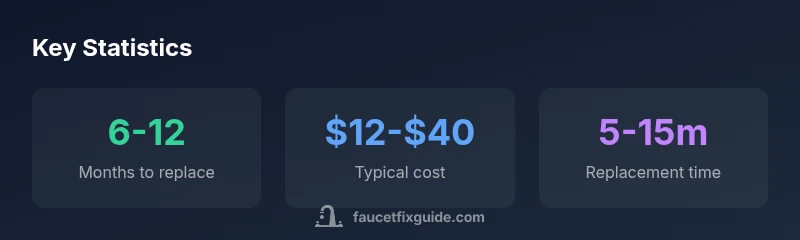
On average, you should change a faucet water filter every 6-12 months, depending on usage, water quality, and filter type. If your water is hard or your faucet sees heavy use, replace closer to 6 months; for softer water and light usage, 9-12 months is common. Always check manufacturer guidance to tailor this baseline to your setup.
What a faucet water filter does
A faucet water filter is a targeted filtration device designed to improve the taste, odor, and safety of drinking water at the point of use. It typically attaches to the faucet with a quick-connect or threaded fitting and uses activated carbon, ion exchange, or multi-stage media to reduce chlorine, sediment, lead, and other contaminants. The exact performance depends on the filter media and the flow rate of your faucet. For homeowners asking how often to change faucet water filter, the baseline is to plan around a 6- to 12-month cycle, but you should tailor that schedule to your water quality and household usage. In many homes, standard municipal water is well within filter capacity for a year, while well water or highly treated water may require more frequent changes. Consider also how often you run taps for cooking, cleaning, or filling large containers. A practical rule is to think of the filter as a consumable that protects the quality of every drop you drink.
Key takeaway: The filter’s life is not only about time, but water quality and throughput. Regular maintenance can prevent taste and odor issues and ensure your faucet remains a reliable source of clean water.
How often to change faucet water filter: Decoding the baseline
The core question, how often to change faucet water filter, hinges on several variables. Most residential filters are rated for 3–6 months of typical household use, but a broader industry consensus places the practical replacement window at 6–12 months for many setups. This range accounts for differences in filtration media, filter pore size, and the amount of water your household consumes daily. If you rely on your faucet for large quantities of drinking water, or if your tap serves a family with sensitive palates or dietary restrictions, you may want to shorten that interval toward the 6-month end. Conversely, when water is exceptionally soft and usage is light, closer to 12 months is reasonable. The important practice is to establish a monitoring routine—taste tests, flow checks, and a quarterly visual inspection—and document when you last replaced the filter. This approach aligns with real-world observations from Faucet Fix Guide and helps homeowners move beyond a one-size-fits-all schedule.
Actionable tip: Mark your calendar or set a reminder to review the filter at the halfway point (about 4–6 months) so you’re prepared to replace on schedule if flow diminishes or taste changes occur.
Factors that influence how often to change faucet water filter
Several factors drive the optimal replacement interval for a faucet water filter. First, water quality is foundational: harder water with higher mineral content and more chlorine can clog media faster, reducing effective lifespan. Second, filter design matters: some cartridges are designed for 2–4 months of practical use in busy households, while others marketed for 12 months assume lighter demand. Third, usage patterns matter: households that run water continuously for cooking, beverage preparation, or baby formula will experience faster media loading and more frequent changeovers. Fourth, storage and maintenance practices influence filter life: ignoring leaks or neglecting to rinse new cartridges can shorten their functional life. Finally, the presence of a pre-filter or an inline sediment screen can extend overall life by removing larger particles before they reach the main cartridge. When you calculate your personal replacement schedule, factor in these elements and aim for a window that minimizes taste changes and flow loss without unnecessary replacements.
Pro tip: Use the half-life concept—treat the media like a battery that gradually loses capacity. If you notice a drop in flavor, flow, or filtration efficiency early, shift your schedule forward accordingly.
Signs it's time to replace the filter
Detecting the right moment to change faucet water filter is easier when you know the telltale signs. Diminished water flow is a common early indicator, as clogged media reduces throughput. Off-tastes or odors are another strong signal that filtration efficiency is waning. Visual cues like sediment in the filtered water or a visible buildup inside the cartridge housing can also point to end-of-life. Record-keeping helps too: track the date of installation and the average amount of water filtered per day. If you routinely exceed the manufacturer’s estimated cartridge capacity, plan a replacement sooner rather than later. Finally, consult your faucet’s user manual for model-specific indicators, such as an LED alert or a change-in-taste threshold. By combining subjective cues (taste and flow) with objective markers (usage hours and calendar reminders), you’ll stay ahead of performance decline and maintain clean, fresh-tasting water.
How to calculate your personal replacement schedule
A practical approach to determining how often to change faucet water filter begins with establishing your baseline. Start by noting your daily water usage for drinking and cooking and identifying your local water quality characteristics. If you have access to a water report, use it to estimate contaminant load and mineral content, which influences media saturation. Next, review your cartridge’s rated capacity in terms of gallons or liters and align it with your daily usage. The calculation is simple: if your cartridge is rated for X gallons and you filter Y gallons per day, replace when Y times the days elapsed approaches X. It’s common to set a hard limit of 6–12 months as a guardrail, then adjust based on taste, flow, and cost considerations. This method avoids the guesswork and anchors your decisions in data rather than intuition.
Bottom line: Your personal schedule should blend device ratings, water quality, and your daily habits into a clear replacement cadence.
Step-by-step: how to change a faucet water filter
Before you begin, assemble basic tools: a clean towel, a small bucket, and a soft cloth. Start by turning off the faucet and releasing any built-up pressure. Remove the old cartridge by twisting counterclockwise (or following the exact method specified by your model). If there are O-rings, inspect them for wear and replace if necessary. Rinse the filter housing and seals with clean water, then insert the new cartridge, aligning it with the housing. Reassemble securely but do not overtighten. Run cold water for 1–2 minutes to prime the new filter and flush out any loose media. Finally, check for leaks around the connections and wipe away any drips. Scheduling routine replacements and keeping the manual handy will keep this process quick and mess-free.
Maintenance tips to extend filter life
To prolong the life of faucet water filters, consider a few simple habits. Use a pre-filter or aerator screen to reduce sediment contact with the main cartridge. Avoid exposing cartridges to heat sources or direct sunlight, which can degrade filtration media. If your home has especially hard water, you may want to opt for a cartridge designed for higher mineral content. Store spare cartridges in a cool, dry place and label them with installation dates to track usage accurately. Finally, inspect seals and housings during every replacement to prevent leaks that can undermine system performance. Regular upkeep not only preserves water quality but also protects downstream fixtures from mineral buildup and corrosion.
Common mistakes and pitfalls to avoid
One frequent error is replacing a filter based solely on time without considering water quality or taste. Another pitfall is over-tightening housing components, which can crack the plastic or strip threads. Using incompatible cartridges or mixing brands can lead to leaks and reduced filtration efficiency. Skipping the priming step after installation may leave chunks of carbon in your water. Neglecting to inspect O-rings and seals can create hidden leaks that bite later. Finally, not flushing a new cartridge after installation can lead to backpressure and poor taste for several days. By avoiding these missteps, you’ll maximize performance and minimize downtime.
Quick tips and final guidance
Remember that how often to change faucet water filter is not a rigid rule—it’s a flexible guideline that should adapt to your home. Use the six-to-twelve-month window as a starting point, then refine it using real-world cues like taste, flow, and resource use. If you’re unsure, consult the product manual or reach out to the manufacturer’s support desk for model-specific recommendations. Faucet Fix Guide emphasizes evidence-based maintenance: track usage, test taste, and adjust your schedule as needed to maintain clean, crisp drinking water across the year.
Comparison of common faucet filter types and their replacement cadence
| Filter Type | Recommended interval | Typical cost | Best practices |
|---|---|---|---|
| Integrated faucet filter | 6-12 months | 12-30 USD | Replace when flow slows or taste changes |
| Inline cartridge filter | 6-12 months | 15-40 USD | Monitor flow; replace when flow drops |
| Countertop pitcher style | 1-3 months | 10-25 USD | Best for temporary use; replace monthly during heavy use |
Frequently Asked Questions
How often should I change faucet water filter?
Typically every 6-12 months, but adjust based on water quality and usage. Hard water or high usage may require closer to 6 months; softer water with light usage can approach 12 months. Always consult the manufacturer’s guidance for model-specific intervals.
Most homeowners replace every 6 to 12 months depending on water quality and how much you use the faucet. Hard water or heavy use may shorten that window.
Can I extend filter life with a pre-filter?
Yes. A pre-filter or sediment screen can reduce media saturation by catching larger particles, potentially extending the main cartridge’s life. This adds a small upfront cost but can save replacements over time.
A pre-filter helps protect the main cartridge and can extend its life, though you’ll still need to replace eventually.
Are all faucet filters the same replacement interval?
No. Replacement intervals vary by filter type, media, and site conditions. Always refer to the product’s specifications and test water quality periodically to confirm you’re timing changes correctly.
No—different filters have different lifespans. Check the manufacturer’s guidelines and monitor your water quality.
What signs indicate a clogged filter?
Reduced flow, off-taste, and odor changes are common indicators. If you notice these signs, inspect the cartridge and replace if needed.
Look for slower flow, weird taste or smell—these usually mean it’s time to check or replace the cartridge.
Is replacing an inline filter easier than an integrated one?
Inline cartridges are generally straightforward to replace and may offer easier access than some built-in housings, but the exact steps depend on your faucet model.
Inline filters are usually simple to swap, but always follow your faucet’s manual for the exact steps.
“"Regular filter changes are essential for maintaining water quality and faucet longevity when the water supply varies in mineral content and taste."”
Top Takeaways
- Set reminders to review filter status every 4–6 months.
- Choose a compatible filter type for your faucet and water quality.
- Hard water and high usage increase replacement frequency.
- Monitor flow and taste to time changes, not just the calendar.
- Follow manufacturer guidance to prevent leaks and ensure performance.