Is Faucet Filter Better Than Pitcher? A Data-Driven Comparison
Compare faucet filters and pitcher filters to determine which delivers safer, better-tasting water with less waste. This analytical guide evaluates filtration coverage, flow, costs, and practicality for homeowners.


For most households, a faucet-mounted filter delivers higher flow, consistent filtration, and greater convenience than a pitcher filter, making it the better overall choice for everyday water quality. A pitcher filter is cheaper upfront but slower to filter, requires frequent refilling, and typically covers fewer contaminants. If your water quality needs are modest and budget is tight, a pitcher can suffice, but for reliability, integrated filtration, and effortless daily use, the faucet option is generally preferred.
Is Faucet Filter Better Than Pitcher? An Analytical Overview
The question is not a simple yes or no. It hinges on water quality goals, daily habits, and budget constraints. In this guide, we examine whether is faucet filter better than pitcher by weighing filtration effectiveness, flow performance, maintenance, and total cost of ownership. The Faucet Fix Guide team emphasizes an evidence-based approach: start with your local water quality, then map that to a filtration solution that minimizes waste while delivering reliable taste and safety. This comparison also considers practical tradeoffs for homeowners, renters, and DIY enthusiasts who want clarity without overpaying.
Filtration Mechanisms: How Each System Works
A faucet filter integrates directly at or near your kitchen faucet, typically using cartridge-based media (activated carbon, KDF media, or ion-exchange resins) to remove common contaminants such as chlorine, sediment, and some metals. Pitcher filters sit in a container and rely on gravity to push water through a cartridge. While both rely on adsorptive media, faucet systems generally offer larger cartridge surface area and faster turnover. This difference matters for households that drink water quickly, pour multiple glasses, or run a busy dishwasher that relies on filtered water.
Contaminants and Water Quality: What Each Filter Targets
Not all filters remove the same contaminants. Faucet filters often focus on taste and odor (chlorine) plus some heavy metals or pesticides, depending on cartridge type. Pitcher filters usually target taste and odor with a focus on chlorine reduction, sometimes offering minerals-preserving designs. If your municipal water contains lead, pesticides, or high levels of sediment, you will want to verify cartridge certifications (e.g., NSF/ANSI standards) to ensure the selected system meets your local water quality goals. The key takeaway is to align a cartridge with the contaminants you want to remove, rather than assuming one solution fits all.
Flow, Convenience, and Daily Use
Flow rate and ease of use are often the deciding factors. Faucet filters typically deliver near-constant flow and no extra container to fill, making a pitcher-based approach slower and more labor-intensive during morning routines. For households that drink many cups of water daily or cook with filtered water, the faucet option reduces the friction associated with filtration. Pitcher filters, by contrast, can be more convenient when you need filtration away from the sink or when you must keep filtered water in a fridge; however, refilling repeatedly can become a nuisance over time.
Cost of Ownership: Upfront, Replacement, and Long-Term Value
Upfront costs vary: faucet filters usually require more initial investment for the mounting hardware or installation, while pitcher filters tend to be cheaper to buy. Ongoing costs include cartridge replacements, which depend heavily on usage and cartridge type. In general, faucet systems provide a higher initial price but can offer longer intervals between replacements if the cartridge capacity is larger and engineered for higher throughput. Pitcher systems often have lower upfront costs but require more frequent cartridge changes due to rapid use and smaller filter media.
Environmental Impact and Waste Considerations
From a waste perspective, faucet filters can be more eco-friendly if designed with reusable housings and longer-lasting cartridges. Some pitcher systems generate more plastic waste due to disposable cartridges or smaller media; others use replaceable cartridges with modest environmental footprints. Individuals who prioritize reducing plastic waste may prefer a faucet solution that leverages refillable cartridges and longer replacement cycles, provided the model fits their water quality needs.
Practical Scenarios: When to Choose Faucet Filter vs Pitcher
If you drink filtered water by the gallon and want the quickest, most consistent flow at the sink, a faucet filter is generally the better option. If you mainly drink water from the fridge and want portability without installation, a pitcher may be the practical choice. For renters or temporary setups without faucet access to filtration, pitchers offer a flexible solution. Always check cartridge certifications and replacement guidance to match your water quality and maintenance tolerance.
Setup, Maintenance, and Replacement Tips
Keep a simple maintenance schedule: record the cartridge replacement intervals recommended by the manufacturer and track usage. For faucet filters, confirm compatibility with your faucet style and ensure a secure seal to prevent leaks. For pitchers, designate a single storage location in the fridge and label replacement dates to avoid infeasible delays. In both cases, always use filtered water for sensitive cooking or baby preparation, and dispose of spent cartridges according to local recycling guidelines.
Common Misconceptions About Home Filtration
A common misconception is that all filters remove the same contaminants. In reality, each cartridge targets a specific set of pollutants, and performance depends on flow rate, contact time, and media type. Another myth is that cheaper filters always save money. In practice, lower upfront prices may come with more frequent replacements or weaker contaminant coverage, leading to higher long-term costs and more waste. Finally, many assume “filters equal purified water.” Filtration improves taste and odor but does not automatically render water fit for every regulatorystandard scenario; always review local water quality data and filter certifications.
Real-World Testing: What to Expect in Daily Use
In real kitchens, you’ll notice that faucet filters reduce chlorine taste quickly, improving overall water perception during cooking and beverages. The pitcher filters provide ample water for fridge storage, but may slow down day-to-day hydration if refilling becomes repetitive. If you have a water quality concern such as sediment or lead elsewhere, verify your cartridge’s certification and ensure you are using the appropriate media. The bottom line is to align filtration with your daily cadence and water quality needs.
Comparison
| Feature | Faucet Filter | Pitcher Filter |
|---|---|---|
| Flow Rate | high/steady | low/variable |
| Filtration Coverage | Broad contaminant removal with cartridge variants | Moderate chlorine/taste/odor reduction |
| Upfront Cost | Higher upfront (hardware/installation) | Lower upfront (pitcher price) |
| Replacement Frequency | Variable by model/usage | Variable by usage/model |
| Waste & Environmental Impact | Often less plastic waste via reusable housings | Potentially more plastic waste from disposable media |
| Installation & Compatibility | Requires faucet compatibility and mounting | No installation; sits on counter or fridge space |
The Good
- Higher daily convenience and faster access to filtered water
- Broader filtration options with cartridge choices
- No need to refill a bottle or pitcher constantly
- Easier integration with kitchen workflow
What's Bad
- Higher upfront cost and installation considerations
- Requires faucet compatibility and occasional maintenance
- Some models may be harder to replace cartridges for non-standard fixtures
- Less portability than pitchers for offsite use
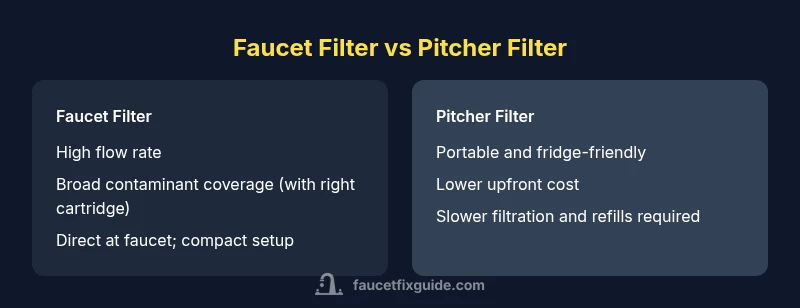
Faucet filters generally win on daily usability and broader filtration; pitchers win on upfront cost and portability
Choose faucet filters if you value quick access and comprehensive contaminant coverage. Choose pitcher filters if budget and portability are your top priorities, provided you accept more frequent refills.
Frequently Asked Questions
What is the main difference between faucet filter and pitcher filter?
The main difference is where filtration occurs and how quickly water is delivered. Faucet filters filter water at the tap with higher flow, while pitcher filters sit in a container and rely on gravity, typically filtering more slowly. Each targets different use cases based on convenience and water quality goals.
Faucet filters filter at the tap for speed; pitcher filters sit in a jug and filter slower. Choose based on convenience and your water quality needs.
Do faucet filters remove more contaminants than pitcher filters?
Filtration performance depends on the cartridge media and certification. Faucet filters can remove a broad range of contaminants when using the right cartridge, often including heavy metals and chemicals. Pitcher filters vary by cartridge; some remove several contaminants, but coverage may be narrower.
Performance depends on the cartridge. Both can remove common contaminants, but confirm certifications for your needs.
How often should I replace cartridges for faucet vs pitcher?
Replacement intervals vary by model and usage. In general, follow the manufacturer’s recommendations and monitor cartridge performance. Regular checks help ensure continued filtration efficacy without surprise declines in water quality.
Follow manufacturer guidance and monitor usage to know when to replace cartridges.
Is pitcher filtration better for travel or camping?
Pitcher filters offer portability and don’t require plumbing changes, making them convenient for travel or camping setups. However, they require access to a water source and refrigeration space for best results, and filtration may be slower or less thorough than faucet models.
Pitchers are portable and easy for trips, but slower and sometimes less thorough.
Are faucet filters compatible with all faucet types?
Most faucet filters fit standard threaded faucets or require an adapter. Specialized faucets may need additional hardware or may be incompatible. Check the product specifications and compatible faucet types before purchase.
Check compatibility with your faucet before buying.
Which is best for drinking water safety in areas with poor water quality?
In areas with poor water quality, faucet filters with certified cartridges can offer robust filtration when matched to target contaminants. Pitcher filters may supplement safety but typically cover fewer contaminants. Prioritize cartridges with credible certifications aligned to your local water data.
Match a cartridge-certified faucet filter to your local water risks for best safety.
Top Takeaways
- Assess your local water quality before choosing a system
- Prioritize flow rate for everyday convenience
- Plan cartridge replacement around your usage pattern
- Weigh up-front costs against long-term savings
- Consider environmental impact and waste when choosing