How to Check Faucet Water Temperature
Learn a safe, accurate method to test faucet water temperature at home. This step-by-step guide covers thermometers, calibration, and practical tips for reliable readings.


Testing faucet water temperature is straightforward: gather a digital thermometer with a probe, run hot water briefly, measure at the faucet stream, and compare against a safe target (about 120°F/49°C). Use repeated readings for accuracy and calibrate as needed.
Why You Should Check Faucet Temperature
Knowing how to check faucet water temperature is essential for safety, comfort, and energy efficiency in any home. When you learn how to check faucet water temperature, you gain practical control over hot-water safety and can prevent scald injuries, especially for children and elderly occupants. This knowledge helps you tune your faucet performance, reduce wasted water, and ensure consistent usability across sinks, bathrooms, and laundry areas. By adopting a reliable measurement routine, you reduce the guesswork that leads to burns or frustration with overly cold water during morning routines.
What Affects Readings at the Faucet
Temperature readings are influenced by several factors: the distance from the water heater, pipe insulation, the valve type (compression, ceramic disk, or cartridge), and whether a recirculation line is present. Measuring too soon after turning on hot water can show a cooler temperature than the steady-state value. Also, running the hot side long enough to flush the line can affect results. Understanding these variables helps you design a measurement method that reflects actual usage and safety.
Tools You’ll Need for Accurate Readings
The core tool is a digital thermometer with a probe that can reach into the faucet stream without being damaged by hot water. You’ll also want a clean container for collecting a sample, a dry cloth for spills, and a notebook or phone to log readings. Additionally, a simple faucet aerator removal tool may be helpful if you want to test temperatures after removing aerators that can influence flow and heat transfer. Having a stable surface to work from reduces the risk of accidents in the sink area.
Safety Standards and Target Temperatures (General Guidance)
While exact standards vary by jurisdiction, a widely recommended target for hot-water safety is around 120°F (49°C). This temperature balances the risk of scalding with practical usability for daily tasks like washing hands, dishes, and filling baths. If your household includes children or elderly individuals, this target becomes even more important. Always adjust based on local codes and the specific needs of your household, and ensure your water heater thermostat is set first to a safe baseline before testing individual faucets.
How to Test: Step-by-Step Method (Overview)
To check faucet temperature accurately, start by preparing your thermometer and testing setup. Run hot water until the flow stabilizes, then insert the thermometer probe into the stream without touching the faucet itself. Wait a few seconds for the reading to stabilize, record the value, and compare it to the safe target. If readings are consistently off by a large margin, consider calibration or testing at multiple taps to verify consistency. This overview sets the stage for the detailed steps that follow.
Calibrating and Verifying Readings
If readings seem off, calibrate your thermometer using ice-water for 0°C or boiling water for 100°C as a quick check, then re-test. If your thermometer is not calibrated, you may get biased results that misrepresent safety. Replace batteries if readings drift suddenly or if the display is faint. Calibration helps ensure your measurements reflect actual temperatures at the faucet.
Common Pitfalls to Avoid
Rushing the test, using a thermometer with a probe that doesn’t reach the flowing water, or testing after only a brief run of hot water can yield misleading numbers. Don’t test with your hand to judge heat level; rely on a thermometer for accuracy. Also, remember that readings can vary by faucet distance and the presence of a recirculation loop, so test at several fixtures for a complete picture.
Practical Scenarios: Kitchens, Bathrooms, and Laundry
In kitchens, you may encounter cooler readings when a long run of cold water precedes hot water due to delivery delay. Bathrooms near the heater can show higher temps because of shorter piping. Laundry faucets might have different temperature profiles depending on pipe routing and water heater proximity. Track each faucet to build a household map of safe temperatures and adjust heater settings if necessary.
Maintenance Tips for Reliable Readings
Regularly inspect the faucet and aerator for mineral buildup that can influence heat transfer. Replace old faucets or worn cartridges that distort readings. Keep thermometers clean and free of mineral deposits; stored properly, a probe thermometer maintains accuracy. Record readings seasonally to detect drift or overheating trends that require attention.
Quick Start Checklist
- Assemble a digital thermometer with probe, notebook, and clean container.
- Run hot water until the stream stabilizes.
- Measure temperature at the faucet stream, away from the aerator if possible.
- Log readings and compare to a safe target (around 120°F/49°C).
- Calibrate or replace the thermometer if readings drift over time.
Tools & Materials
- Digital thermometer with a probe(Ensure probe can withstand hot water; clamp or hold away from splashes.)
- Clean measuring container(Use a container to collect water if you’re testing downstream or for extended readings.)
- Dry cloth(Keep the area dry to avoid slips and protect electronics.)
- Notepad or smartphone(Log temperatures and times for comparison over multiple taps.)
- Faucet aerator wrench(Optional for removing aerators to test temperature after flow adjustment.)
Steps
Estimated time: 15-25 minutes
- 1
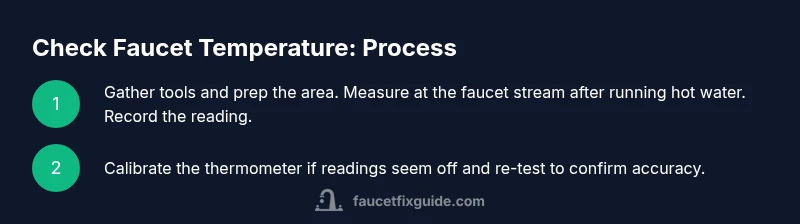
Gather tools and prep the area
Collect a digital thermometer with a probe, a clean container, a dry cloth, and a notebook. Clear the sink area to prevent spills and ensure you have a stable working position. This step sets the stage for accurate measurement.
Tip: Keep the thermometer dry and rated for the expected water temperature to avoid damage. - 2
Identify the faucet you will test
Choose a faucet that represents typical use (kitchen or bathroom). Ensure the faucet handle is accessible and that you can run water without splashing nearby surfaces. Testing the main sink faucet gives you a baseline measurement.
Tip: If you have multiple faucets, test at least two representative points to map variability. - 3
Run hot water to steady state
Turn on the hot water fully and let it run for 20–30 seconds to flush the line and reach a stable temperature. Note that some pipes may retain heat and alter readings if you start measuring too soon.
Tip: Avoid measuring while the faucet is cooling after a long draw; wait a moment for stabilization. - 4
Take the temperature reading
Dip the thermometer probe into the running water stream, keeping it away from the aerator if possible. Wait 5–15 seconds for the reading to stabilize, then record the value. Ensure the probe tip is fully immersed for an accurate result.
Tip: If the reading fluctuates, take three consecutive measurements and average them. - 5
Compare to the safety target
Compare the measured temperature with the target safe range (roughly 120°F/49°C). If readings exceed or fall short consistently, plan adjustments or further testing at other fixtures.
Tip: Remember that local building codes may influence recommended temperatures; verify with local guidelines. - 6
Calibrate and re-test as needed
If readings seem off, calibrate the thermometer using ice-water for 0°C or boiling water for 100°C. Re-test to confirm accuracy before making any heater adjustments.
Tip: If readings remain inconsistent after calibration, consider replacing the thermometer sensor.
Frequently Asked Questions
What is a safe faucet water temperature for households?
Many safety guidelines suggest keeping hot water around 120°F (49°C) to minimize scald risk while remaining practical for daily use. Always check local codes and adjust for household needs.
A common safe target is about 120 degrees Fahrenheit, but follow local codes and your household needs.
How often should I check faucet temperature?
Test when installing a new faucet or water heater, after maintenance, or if you notice temperature inconsistencies. Regular checks help catch drift in readings over time.
Test during installation or after maintenance, and whenever you notice temperature changes.
Can I estimate temperature without a thermometer?
A thermometer provides objective readings. Without one, you risk under- or overheating. Use a digital thermometer for precise results.
Estimating is risky; use a thermometer for precise results.
Why does temperature vary between taps?
Differences arise from pipe length, heater distance, and valve settings. Test multiple fixtures to map the true range in your home.
Differences happen because of pipe length, heater distance, and valve settings.
What should I do if readings are off from the heater thermostat?
Test at several taps to confirm drift. If readings are consistently off, recalibrate the thermometer or adjust the heater thermostat within safe limits after verifying with codes.
If readings don't match expectations, recheck with multiple taps and calibrate.
Is it safe to calibrate with boiling water?
Calibrating with boiling water is common, but handle carefully to avoid burns. Use proper equipment and allow the thermometer to stabilize after changes.
Yes, but handle boiling water with care and proper equipment.
Watch Video
Top Takeaways
- Test hot and cold taps to gauge safety.
- Use a calibrated digital thermometer for accuracy.
- Keep hot-water heater at a safe setting around 120°F (49°C).
- Re-test after any heater or faucet maintenance.