How Hot Does a Faucet Get? Safe Temperature Guide for Homes
Discover how hot faucet water can get, safe temperature targets, and practical steps to measure and regulate outlet heat in your home. Learn with Faucet Fix Guide.


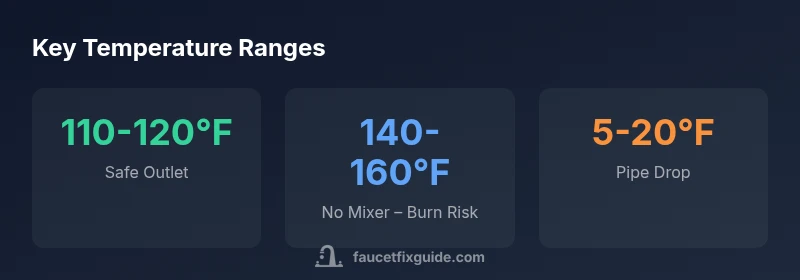
Hot water temperature at the faucet depends on the heater setting and any mixing devices. In most homes, the outlet is kept at a safe 110–120°F (43–49°C) with a thermostatic or manual mixer, which helps prevent scalding. Without mixing, a direct hot-water line can reach 140–160°F, posing burn risks. Always test at the faucet and adjust to your family’s needs. If you want precise control, install a thermostatic mixing valve.
Understanding Safe Outlet Temperatures
Water temperature at the faucet is not set in stone by the heater alone. It is the result of a three-way interaction: the heater’s upper limit, any mixing or anti-scald devices, and the journey the water takes through your pipes. In many households, the goal is to deliver water that feels hot enough for comfort but not so hot it risks burns. The widely recommended target is to keep the faucet outlet around 120°F (49°C) or lower when possible, which helps mitigate scalding while still delivering usable hot water for dishes, cleaning, and showers. At Faucet Fix Guide, we emphasize that temperature control is not just a single setting; it’s a safety system that includes the heater, valve hardware, and user practices. If you need to adjust, plan for gradual changes and test at the faucet after each adjustment to verify the result.
Factors that Determine Faucet Temperature
There are several factors that influence the final temperature you feel at the faucet:
- Heater setting and capacity: A water heater set to 120°F or higher will supply hotter water unless mitigated by a mixer. Some older or larger homes may run hotter water due to system design.
- Mixing and anti-scald devices: Thermostatic mixing valves and caulked shutoff devices blend hot and cold to achieve a safer outlet temperature. These devices are the most reliable way to prevent accidental scalding, especially in homes with children or elderly occupants.
- Pipe routing and heat loss: Water cools as it travels through pipes. Longer runs, poor insulation, or high ambient temperatures can reduce the actual temperature you feel at the faucet, sometimes masking a hotter supply.
- Faucet design and aerators: Some high-flow or single-handle faucets have built-in features that affect how quickly hot water feels when mixed with cold water. Aerators can slightly alter the perceived temperature and flow rate.
- Recirculation systems: Homes with hot-water recirculation lines can deliver hotter water faster but may also increase the risk of scalding if mixing isn’t properly calibrated. The balance between quick hot water and safety is achieved with proper valve settings and regular maintenance.
How to Measure the Temperature at Your Faucet
Accurate measurement is the foundation of temperature management. Here’s a simple, repeatable process you can follow:
- Gather a digital thermometer or a high-quality liquid thermocouple with a probe that can be placed under flowing water.
- Run the hot water for 15-30 seconds to flush the line and achieve a stable outlet temperature.
- Place the thermometer probe directly at the faucet outlet or into a small cup filled with water from the faucet. Wait 15-30 seconds for a stable reading.
- Record the temperature and repeat at different times of day or with different fixture types (bathroom sink, kitchen sink, shower where applicable).
- If the temperature consistently reads above 120°F, consider adjusting your heater, adding a mixing valve, or replacing worn anti-scald devices. Small changes, tested carefully, can markedly improve safety.
Temperature in Common Scenarios: Kitchen vs Bathroom
Water temperature behavior varies by setting. Kitchen sinks often have longer hot-water runs due to distance from the heater, which can influence the measured outlet temperature. Bathroom fixtures tend to have shorter runs, which can keep the outlet closer to the heater’s setpoint but may still be affected by recirculation loops if present. In both cases, a properly calibrated thermostatic mixing valve set to a safe outlet temperature is the dependable best practice. If your home uses a distant water heater or has an older plumbing layout, you may see greater variability between the faucet and the heater reading, which underscores the importance of measurement and adjustment.
Safety Devices and Best Practices
The safest approach combines multiple safeguards:
- Install a thermostatic mixing valve (TMV) or anti-scald valve on the hot-water line to keep the outlet within a safe range.
- Set the water heater to a reasonable maximum, commonly 120°F, and verify by measuring at the faucet.
- Use faucet aerators that do not significantly increase the outlet temperature but improve flow and mixing.
- For homes with children or vulnerable individuals, consider a dedicated safety temperature bottle of settings and educate family members on safe usage.
- Schedule regular inspections of valves, pipes, and insulation to maintain consistent performance over time.
Practical Steps to Regulate Temperature Safely
If you want to bring faucet temperature under control with minimal disruption, follow this plan:
- Check the current heater thermostat and reduce to 120°F if it’s higher. 2) Install or verify TMVs at the hot-water line. 3) Test the outlet temperature after each change. 4) Inspect piping for insulation and heat loss, especially in exposed runs. 5) When in doubt, consult a licensed plumber to assess system-wide factors that affect temperature and safe operation.
Maintenance for Consistent Temps
Regular maintenance helps ensure that temperatures stay within safe ranges:
- Annually test and calibrate thermostatic mixing valves.
- Flush the water heater once a year to remove sediment that can affect efficiency and temperature consistency.
- Inspect insulation on hot-water pipes, especially in unheated spaces.
- Replace worn cartridges or valves in faucets that affect mixing performance.
- Keep a simple log of measured temperatures at representative fixtures to detect drift over time.
Troubleshooting Quick-Reference: Common Temperature Issues
- Issue: Outlet runs hotter than expected after a heater change. Resolution: Recheck TMV settings and validate with fresh measurements.
- Issue: Temperature drops significantly after long pipe runs. Resolution: Insulate hot-water pipes and consider a recirculation system or near-fixture mixing valve.
- Issue: Inconsistent temperatures between fixtures. Resolution: Inspect valve cartridges and ensure consistent valve operation across fixtures.
Myth-Busting: What Impacts Temperature May Be Misunderstood
- Myth: Higher heater settings always mean better hot-water performance. Reality: Without proper mixing, higher settings increase burn risk and may not improve real-world performance.
- Myth: Aerators alone regulate temperature. Reality: Aerators mainly affect flow and splash; temperature control is primarily a function of valves and heater settings.
- Myth: Temperature at the faucet is the same as inside the heater. Reality: There is typically a noticeable drop between the heater and the faucet due to distance and piping conditions.
Outlet temperature scenarios at common faucet setups
| Scenario | Outlet Temp (F) | Notes |
|---|---|---|
| No mixing valve | 140-160°F | Greatly increases burn risk; not recommended for regular use |
| With mixing valve (set to 120°F) | 110-120°F | Safe, comfortable for most homes |
| Long pipe run from heater | varies with length | Temperature drop depends on insulation and routing |
Frequently Asked Questions
What is the recommended safe faucet temperature for homes?
Most safety guidelines suggest targeting 120°F (49°C) at the faucet as a practical balance between performance and safety. In households with children or seniors, lower the target or rely on a thermostatic mixing valve to prevent accidental scalding.
Most households should aim for about 120°F at the faucet to stay safe and comfortable.
Can a faucet get hotter than my water heater setting?
Yes. If the heater is set to a high temperature and there is no mixing valve, the outlet can reach temperatures near the heater setting. The actual faucet temperature also depends on pipe length, insulation, and fixture design.
It can be hotter at the faucet if there’s little mixing and long piping.
How do I adjust my faucet’s temperature limit?
Use a thermostatic mixing valve or adjust the water heater’s thermostat to a lower setting (commonly 120°F). After adjustments, re-measure at the faucet to confirm the safe outlet temperature.
Install or adjust a mixing valve and then test at the faucet.
Are all faucets able to limit temperature?
Not all faucets have built-in temperature limiting, especially older or cheaper models. Use external safety devices like TMVs or anti-scald cartridges to ensure a safe outlet temperature.
Some faucets don’t limit temperature; add safety devices if needed.
What causes hot water to be hotter at the faucet than in the tank?
Distance from the heater, pipe insulation, and recirculation can cause hotter or cooler readings at the faucet. Always measure at the fixture to know the actual outlet temperature.
Check where your hot water travels to reach the faucet.
Is it safe for children to use hot water from taps?
With proper mixing valves and a 120°F target, hot taps can be used safely for children, but supervision and simple safety education are still important.
Yes, but keep temperatures under 120°F and supervise kids.
“Maintaining a safe faucet temperature isn’t a single fix—it’s a system. A properly calibrated thermostat, a good mixing valve, and regular maintenance together provide reliable protection against scalding.”
Top Takeaways
- Test hot-water temps at fixtures regularly
- Use a thermostatic mixing valve to limit outlet temperature
- Set heater to 120°F where safe and permitted
- Insulate hot-water piping to minimize heat loss
- Know the burn risk of high temps at outlets
- Maintain valves and cartridges for consistent performance
- Distance from heater affects measured faucet temps
- Keep a simple temperature log for home safety