Delta Shower Faucet Leaking: Quick Fix Guide
Learn how to diagnose and fix a Delta shower faucet leaking with a practical, step-by-step guide from Faucet Fix Guide. Safety tips, common causes, troubleshooting flow, and prevention to keep your shower drip-free.


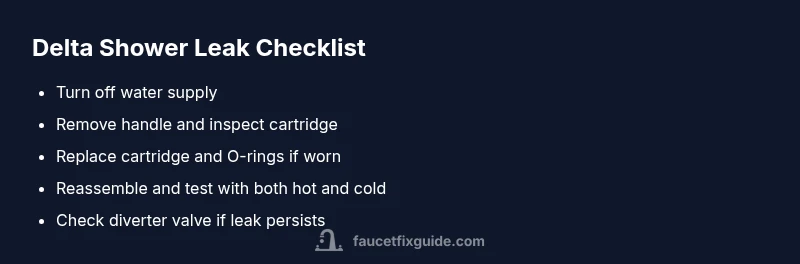
A leaking Delta shower faucet is most often caused by a worn cartridge or O-rings. Start by turning off the water, removing the handle, and inspecting the cartridge and seals. If the drip persists, replace the cartridge or O-rings, and check the diverter valve if applicable. For stubborn leaks, contact Faucet Fix Guide for professional guidance.
Delta Shower Faucet Leaking: Why It Demands Attention
A dripping shower is more than a nuisance; it wastes water and can drive up utility bills over time. For Delta fixtures, most leaks originate from wear in the cartridge or damaged O-rings, especially after years of use or mineral buildup. The Faucet Fix Guide team notes that addressing leaks early prevents corrosion and reduces the chance of more serious plumbing issues down the line. By understanding the common failure points and following a structured troubleshooting flow, you can usually stop the drip without replacing the entire faucet. This guide emphasizes safe DIY steps for homeowners, renters, and DIY enthusiasts who want reliable fixes and long-term prevention.
Recognizing Symptoms and Determining Scope
Leaks in Delta shower faucets come in several flavors: a slow drip that keeps time with the water cycle, a constant stream even when the handle is off, or a dripping spout with the handle tightened. The first clue is where the leak appears: handle, spout, or shower arm. Handle leaks often point to cartridge wear or packing nut issues, while spout leaks can indicate cartridge failure or diverter problems in a multi-function model. By noting whether the leak occurs with specific temperatures, water pressure, or after the faucet is turned on for a while, you’ll narrow the root cause quickly. Faucet Fix Guide recommends documenting symptoms before disassembly to avoid confusion during reassembly.
Safety First: Prepare, Protect, and Power Down
Before you touch any plumbing, shut off both the hot and cold water supplies to the area. If you don’t have local shutoffs, switch off the main house valve. Place towels or a bucket to catch residual water and protect surrounding surfaces. Gather your tools: an Allen wrench, screwdriver, adjustable wrench, replacement cartridge (matched to Delta model), new O-rings or packing nut kit, and plumber’s grease. Wearing eye protection is wise, especially if mineral buildup is present. Taking photos through each disassembly step helps with reassembly and reduces mistakes.
Diagnostic Flow: Symptom → Diagnosis → Solutions
Start with the simplest checks. If the leak only occurs at higher water pressure, the issue may be pressure-related or due to worn cartridge seals. If the leak persists after tightening, the cartridge is a prime suspect. A leaky diverter valve in a shower-with-tauc or three-function valve may produce leaks when switching modes. Use the diagnostic flow to move from easy fixes to more complex repairs, and always test progressively after each step. If you reach a stage where the cartridge cannot be removed without force, stop and seek professional help to avoid damage to caliper seats or the valve body.
Common Causes: Cartridge, O-Rings, and Diverters
In Delta systems, the cartridge is the most frequent failure point. Over time, the cartridge’s internal seals wear down, causing leaks at the handle or when pressure changes. Damaged O-rings and packing nuts can also leak, especially where the handle meets the stem. In multi-function fixtures, the diverter valve can fail, leading to leaks when switching from shower to tub modes. Mineral buildup from hard water can hasten wear on all these components. Addressing the exact part—cartridge, O-rings, or diverter—will yield the most durable fix.
Step-by-Step Repair: Replacing a Delta Cartridge (Overview)
Replacing a Delta cartridge requires careful disassembly to avoid damaging the valve body. Confirm the cartridge type (Delta RP19804, RP5053, etc.) by removing the handle and looking at the cartridge model. Purchase a matching replacement and assemble in the reverse order. After installation, flush the system to clear debris and verify that the leak is resolved. If you’re unsure about model compatibility, bring the old cartridge to the hardware store for exact matching. This section provides a patient, methodical approach so you can complete the repair with confidence.
Preventative Maintenance: Extend the Life of Your Faucet
To prevent future leaks, perform regular inspections of the cartridge and O-rings, especially after mineral buildup or a hard water period. Clean the valve stems and check the packing nut for loosening. Use plumber’s grease on seals when reassembling and avoid overtightening screws. Keep the water potential low by installing a water softener if you have hard water, which reduces mineral scale and slows wear on internal parts. Routine maintenance helps you catch wear before it becomes a leak.
When to Call a Professional: Knowing Your Limits
Some Delta faucets have non-removable or pressure-rated cartridges that require special tools or professional calibration. If the faucet is under warranty, DIY replacement may void it—check the manufacturer policy first. If the fixture is older, the risk of damaging valve seats or plumbing connections increases. In these cases, a licensed plumber can prevent costly errors and ensure a proper seal, especially in tight or hard-to-reach locations.
Quick Safety and Best-Practice Checklist
- Always shut off water first and verify no flow.
- Use eye protection and keep a towel ready for spills.
- Match cartridge replacements precisely to your Delta model.
- Do not over-tighten packing nuts or screws—hand-tight plus a quarter-turn is often enough.
- Test leak resolution by running hot and cold water for several minutes and re-checking for drips.
Summary of What You Need to Do Next
If you’re facing a Delta shower faucet leaking, start with the simplest fix: replace O-rings or the cartridge if required, then verify by running water at varying pressures. If the leak persists, revisit the diagnostic flow, check the diverter valve, or call a pro. Faucet Fix Guide emphasizes systematic troubleshooting to avoid unnecessary part replacements and to ensure a durable seal.
Steps
Estimated time: 45-60 minutes
- 1
Shut off water supply
Turn off both hot and cold lines at the faucet or house main. Open the faucet to relieve any remaining pressure and verify there is no water flow intended to avoid splashing.
Tip: Keep towels handy to absorb residual water. - 2
Remove the handle
Use the correct screwdriver or hex key to remove the handle screw. Gently lift the handle away from the stem, exposing the cartridge and stem.
Tip: Note the handle orientation for reassembly. - 3
Inspect the cartridge and seals
Carefully extract the cartridge with pliers, keeping it level to avoid damage. Inspect O-rings and packing nut for cracks or wear; replace if necessary.
Tip: Take a photo of the cartridge before removing it. - 4
Install the replacement cartridge
Insert the new cartridge in the same orientation as the old one. Re-seat firmly and ensure it sits flush against the valve body.
Tip: Apply a light coat of plumber’s grease to O-rings. - 5
Tighten and reassemble
Reattach any seals, packing nut, and the handle. Do not overtighten any screws; snug is usually enough to create a proper seal.
Tip: Double-check screws for symmetry before final tightening. - 6
Test for leaks
Turn the water back on and run hot and cold to flush debris. Observe for drips at the handle and spout for several minutes.
Tip: If leaks continue, pause and re-check cartridge seating. - 7
Advanced checks or diverter test
If a leak persists after cartridge replacement, inspect the diverter valve and the spout connections. Consider professional evaluation for valve body issues.
Tip: Document symptoms and parts replaced to speed up service if you call a pro.
Diagnosis: Delta shower faucet leaking
Possible Causes
- highWorn or damaged Delta cartridge
- mediumDamaged O-rings or packing nut
- lowDiverter valve issue in a multi-function shower
Fixes
- easyReplace the cartridge with a matching Delta model
- easyReplace O-rings and packing nut as needed
- mediumInspect and clean the diverter valve or replace it
- hardConsult a licensed plumber for cartridge-seat or valve body issues
Frequently Asked Questions
What causes a Delta shower faucet to leak at the handle?
Handle leaks are usually caused by worn cartridge seals or a damaged packing nut. Replacing the cartridge and reseating packing components often stops the drip. If the leak remains, the valve may need professional attention.
Handle leaks are typically due to worn seals or packing that needs replacement. Replacing the cartridge usually fixes it, but if it continues, you may need a pro.
Can I fix a Delta shower faucet leak myself?
Many leaks are DIY-fixable with basic tools and matching Delta cartridges. Always shut off water first, use correct parts, and follow manufacturer guidance. If you feel uncertain or the faucet is old, consider a professional plumber to avoid damage.
Yes, many leaks are DIY fixable, but shut off water first and use the right parts. If you’re unsure or the faucet is old, call a plumber.
What tools do I need to replace a Delta cartridge?
Common tools include an Allen wrench, screwdriver, adjustable wrench, cartridge puller, and replacement cartridge. Having plumber’s grease and a towel or bucket helps with clean-up and seating.
You’ll typically need an Allen wrench, screwdrivers, a wrench, and the replacement cartridge, plus grease and towels.
How long does a cartridge replacement take?
A cartridge replacement typically takes about 45-60 minutes for a straightforward fix. More complex setups or diverter-valve work may extend this time, especially if parts are hard to access.
Most cartridge replacements take under an hour, with longer times if the valve is hard to reach or if other parts need attention.
Should I replace the entire faucet if the leak persists?
If repeated cartridge changes fail or the faucet body shows corrosion, replacing the faucet could be more cost-effective and reliable. A plumber can help determine whether replacement or refurbishment is best.
If leaks persist after multiple cartridge replacements, it might be better to replace the faucet and consult a pro.
Is it safe to use leak sealants for Delta fixtures?
Most leak sealants are not recommended for Delta cartridges as they can interfere with seals and water flow. Use manufacturer-approved parts and materials for replacements.
Sealants aren’t recommended for Delta carts—stick to approved parts and follow the manufacturer.
Watch Video
Top Takeaways
- Shut off water before starting repairs
- Cartridge wear is the top leak culprit
- Replace worn O-rings and seals as needed
- Test thoroughly after each repair step
- Seek professional help for diverter or valve-seat issues