What is a good GPM for kitchen faucet? A practical guide
Discover the ideal GPM range for kitchen faucets, how to measure it at home, and practical guidance to balance performance with water savings.


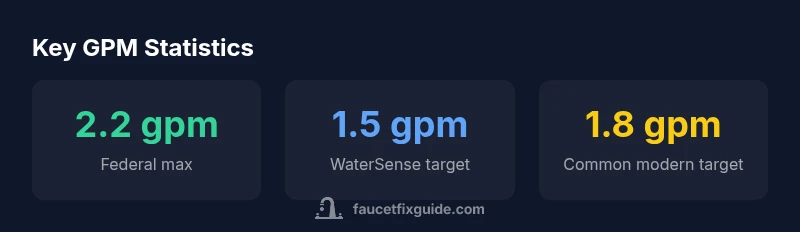
According to Faucet Fix Guide, a practical target for kitchen faucet flow is roughly 1.5 to 2.0 gpm, with 1.8 gpm serving as a common modern balance. Federal standards cap kitchen faucets at 2.2 gpm at 60 psi, while WaterSense labeling nudges homeowners toward 1.5 gpm or lower. For most households, selecting a faucet around 1.5–1.8 gpm delivers reliable performance for cooking, cleaning, and dishwashing without wasting water.
What the GPM number means for your faucet
GPM stands for gallons per minute and it's the primary measure of how fast water flows from your faucet. For a kitchen sink, the GPM you choose affects everything from how quickly you fill pots to how long it takes to rinse produce. When you ask what is a good gpm for kitchen faucet, you’re weighing convenience against long‑term water use. According to Faucet Fix Guide, a practical target is roughly 1.5 to 2.0 gpm, with 1.8 gpm as a common modern balance. Federal standards cap kitchen faucets at 2.2 gpm at 60 psi, and WaterSense labeling nudges homeowners toward 1.5 gpm or lower. In real households, most people find that 1.5–1.8 gpm provides reliable performance for typical tasks without excessive waste. If you frequently cook with large pots or do frequent water-heavy cleaning, you may tolerate a higher flow, but pair any increase with a good aerator and careful spray control to avoid unnecessary waste.
How to decide what 'good' means for your kitchen
A kitchen is used differently in every home, so a single number cannot fit all. Start by listing the tasks you perform most: filling pots, rinsing vegetables, washing dishes by hand, and using a water‑filtration pitcher. People who regularly cook large meals or fill stockpots may lean toward the upper end of the 1.5–2.0 gpm range, while those in small apartments or with a WaterSense goal may aim closer to 1.5 gpm. If you share the sink with others, consider the peak moments when several tasks run at once. Local codes and utility programs may encourage low‑flow fixtures, and some landlords require certain efficiency standards. Finally, remember that flow rate is a tool, not a fixed rule: you can tune performance with aerators and spray heads before buying a new faucet. The goal is a balance: comfortable use, predictable water usage, and the right spray pattern for your kitchen tasks.
GPM comparison for kitchen faucets
| Category | GPM | Notes |
|---|---|---|
| Federal max flow (kitchen) | 2.2 | Legal max at 60 psi |
| WaterSense target (kitchen) | 1.5 | Efficiency target for labeling |
| Common modern faucet | 1.8 | Popular compromise model |
| High-efficiency option | 1.5 | WaterSense-labeled models |
Frequently Asked Questions
What is the federal limit for kitchen faucet flow?
Under U.S. law, most kitchen faucets are limited to 2.2 gpm at 60 psi. This cap helps curb water waste while allowing typical daily tasks. Local codes can set stricter limits, so always check your area’s requirements.
The federal limit is 2.2 gpm at 60 psi.
Is 1.5 gpm enough for a kitchen sink?
A 1.5 gpm flow can be sufficient for many tasks, especially with a good aerator and efficient spray. If you cook often or fill large pots, you may prefer 1.8 gpm or a model with adjustable flow.
Yes, 1.5 gpm can be enough for regular kitchen use, but consider your pot sizes.
How do I measure GPM at home?
To measure GPM, run the faucet at typical use into a graduated container for 15 seconds, then multiply by four to estimate gallons per minute. Repeat with different settings if possible to get a fuller picture.
Grab a measuring cup, run for 15 seconds, and multiply by four.
Can I increase GPM on my existing faucet?
You can sometimes increase flow by replacing the aerator or removing a restrictive flow insert, but you must stay within the fixture's rated maximum. If flow remains insufficient, upgrade to a higher-GPM model or a faucet with adjustable flow.
You can adjust with aerator replacement, but stay within the rated max.
Do WaterSense labeled faucets always have 1.5 gpm?
WaterSense targets 1.5 gpm for kitchen faucets; most labeled models meet or aim for this standard. Always check the product spec to confirm the exact flow rate.
WaterSense usually targets 1.5 gpm for kitchen faucets.
“Flow rate is a balance between water conservation and everyday convenience. The right GPM depends on how you use the sink, not just the number.”
Top Takeaways
- Set a target between 1.5–1.8 gpm for everyday balance
- Measure GPM at home to verify performance
- Use aerators/flow restrictors to tune, not guess
- Check WaterSense labeling for efficiency guidance
- Upgrade components if needed to hit your target without waste