Difference Between Faucet and Valve: A Practical Guide
Explore the difference between faucet and valve, how they interact in residential plumbing, common failure modes, and DIY tips to diagnose and fix leaks without unnecessary replacements.


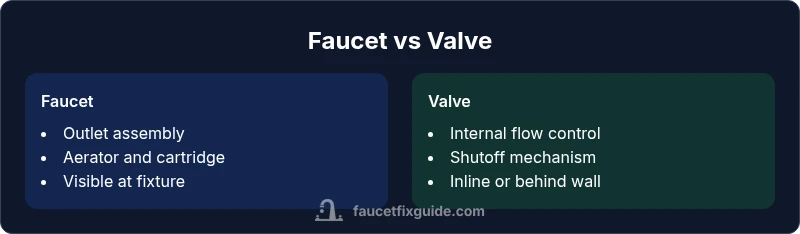
From a homeowner's perspective, the difference between faucet and valve is foundational. A faucet is the full outlet assembly that delivers water with a handle, cartridge, and aerator, while a valve is the internal shutoff mechanism inside or upstream of the fixture that actually controls flow. Understanding this helps diagnose leaks, replacements, and maintenance more accurately.
Understanding the difference between faucet and valve
When you hear plumbers talk about the difference between faucet and valve, they are distinguishing two related but distinct components in a water-supply system. In most homes, the faucet is the visible, controllable end of the line that you interact with daily to get water for washing, cooking, or cleaning. The valve is the internal or upstream mechanism that actually starts or stops the flow of water. This distinction matters for diagnosing leaks, planning replacements, and budgeting for repairs. According to Faucet Fix Guide, clarifying which part is failing helps you avoid replacing the wrong component and speeds up the repair process. The distinction also affects what parts you might need, such as cartridges, seats, stems, or packing material.
Core roles and functional scope
A faucet provides the physical outlet and the user interface for water delivery. It includes the spout, aerator, cartridge, handle, escutcheon, and sometimes a mixer inside the body. A valve, by contrast, is the control element that stops or permits water flow in the supply line or inside the fixture. Valves regulate pressure and flow, and they can exist as shutoff valves under sinks, angle stops at the wall, or cartridge-based valves embedded in the faucet body. Understanding where the valve sits helps with accurate troubleshooting and longer system life. Faucet Fix Guide emphasizes thinking in terms of function—outlet vs control—to guide repairs.
How flow is managed in everyday use
When you turn a faucet handle, you are actuating a mechanism inside the faucet that opens a passage and blends hot and cold water through a cartridge or mixer. The valve beneath or behind the scene determines the actual availability of water by opening or closing a flow path. If the faucet delivers weak spray, poor aeration, or inconsistent temperature, the issue often traces to the faucet's cartridge or aerator rather than the upstream valve. If water keeps running after you shut off the handle, the valve segment may be failing. This functional split helps homeowners diagnose issues without unnecessary part replacement and informs maintenance planning.
Common failure modes and diagnostic clues
Faucets typically fail due to worn cartridges, degraded O-rings, mineral buildup in aerators, or seated leaks where the interior cartridge loses a tight seal. Symptoms include dripping from the spout when off, reduced water flow, or sputtering spray. Valves fail in ways that primarily affect shutoff ability: a valve may drip after being closed, leak around the stem, or fail to fully stop flow despite the handle position. Diagnosing requires isolating the symptom: isolate water supply to confirm whether the issue is at the fixture level (faucet) or in the supply line (valve). A systematic approach reduces guesswork and prevents unnecessary replacements.
Replacement versus repair: decision framework
Deciding whether to replace a faucet or a valve hinges on repair feasibility, cost, and expected lifespan. If a faucet shows widespread wear, cartridge failure, or corroded components, replacement may be the most reliable option. If a valve shows slow wear or a stubborn leak at the shutoff, repairing or replacing the valve assembly can restore performance without changing the entire faucet. In many cases, a single faulty cartridge or valve stem is cheaper and faster to address than a full fixture replacement. Consulting a guide or professional can help confirm the best route based on symptoms and fixture age.
Tools, parts, and preparation for DIY checks
DIY checks begin with simple noninvasive tests: turn off the water supply to the fixture and inspect for visible leaks around the handle, cartridge, and aerator. Gather basic tools such as adjustable pliers, screwdrivers, replacements for cartridges or seats, plumber's grease, and clean rags. For faucets, a spare cartridge, O-rings, or aerator screens can address common issues. For valves, you may need a packing nut wrench, replacement stems, or valve seats. Always work with the water off, pressurize slowly when reactivating, and test each function—hot, cold, and both mixed—before finalizing repairs.
Maintenance habits to extend life and prevent surprises
Routine maintenance is more about prevention than a dramatic repair. Regularly clean aerators and screens to prevent mineral buildup, inspect packing nuts for signs of seepage, and exercise valves monthly to prevent sticking. Use a mild descaler if mineral deposits are visible, but avoid harsh chemicals that could damage seals. Keep a small parts kit handy with O-rings and replacement cartridges appropriate for your fixtures. Document aging components to anticipate replacement timelines and avoid last-minute shopping during a leak.
When to call a professional: risk assessment and safety
A professional should be consulted when leaks persist after replacing cartridges or when you encounter corroded valve bodies, hidden leaks, or complex assemblies behind walls. A professional can perform pressure tests, verify soldered connections, and ensure compliance with local codes. Valves embedded in wall cavities or behind cabinets may require special access, making professional help more efficient and safer. If you are unsure about pipe material, corrosion level, or working around electrical components near the sink, it's wise to call a licensed plumber.
Real-world scenarios: quick case studies and lessons learned
In one household, a persistent drip at the faucet was traced to a worn cartridge rather than the supply valve, leading to a low-cost cartridge replacement and a longer fixture life. In another, repeated running water with no shutoff was traced to a faulty shutoff valve behind the wall, which required replacing the valve assembly. These cases show why distinguishing faucet components from valve mechanisms matters: the right diagnosis saves time, money, and disruption to daily routines.
Practical tips for ongoing care and upgrades
For ongoing care, focus on cleaning and inspecting the visible faucet parts while keeping spare cartridges, seats, and aerator screens. When upgrading, prioritize fixtures with accessible replacement cartridges to simplify future maintenance. Consider labeling your shutoff valves at the source to improve future diagnostics, and schedule periodic checks to catch wear early. These habits can reduce the frequency of larger repairs and help maintain water efficiency across your fixtures.
Comparison
| Feature | Faucet | Valve |
|---|---|---|
| Primary role | Delivers water at the outlet with user control | Manages start/stop of flow in the supply path |
| Location in system | Visible fixture end and body | Inline in supply line or inside fixture assembly |
| Common failure symptoms | Drips from the outlet; aerator or cartridge issues | Continuous flow; leaks at shutoff; difficulty turning handle |
| Typical repair approach | Replace or reseat cartridge; clean aerator; replace O-rings | Repair or replace shutoff valve; reseal packing; replace stem |
| Impact on water quality | Can affect spray quality and temperature control via cartridge/aerator | Primarily affects flow control; indirect impact on water quality via leaks |
| Best for | Daily use and fixture performance | Reliable shutoff and long-term flow control |
The Good
- Clarifies diagnostic pathway for leaks and failures
- Improves maintenance planning and part compatibility
- Reduces unnecessary fixture replacements
- Helps homeowners choose correct parts (cartridges, stems, seats)
What's Bad
- Can be confusing for DIY beginners without plumbing background
- Some fixtures integrate faucet and valve components, reducing clarity
- Misdiagnosis can lead to unnecessary replacements if symptoms are subtle
Different roles, different repairs: identify symptom to choose faucet versus valve work.
Faucets and valves serve distinct purposes. Faults at the outlet point to the faucet, while faults in flow control point to the valve. Correct diagnosis saves time, money, and ensures reliable operation.
Frequently Asked Questions
What is the difference between faucet and valve?
A faucet is the complete outlet assembly that delivers water, while a valve is the internal mechanism that starts or stops flow. They serve different functions, so symptoms help pinpoint which part needs attention.
A faucet is the whole outlet you use; a valve is the internal control that regulates flow. Symptoms tell you which part to fix.
Can a leaky faucet be fixed without replacing the valve?
Often yes. Leaks from the faucet body usually involve worn cartridges or O-rings, which can be replaced without touching upstream valves. If leaks persist after cartridge replacement, the valve may be at fault.
Yes. Most faucet leaks come from worn cartridge parts and can be fixed without touching the valve. If it keeps leaking after replacement, check the valve.
Where is the valve located in typical sinks?
Valves are typically found under the sink on supply lines or behind the wall as shutoff valves. They may be angle stops or inline valves connected to the faucet assembly.
Valves are under the sink on the supply lines or behind the wall; look for shutoff valves near the pipes.
When should I replace a faucet vs a valve?
Replace the faucet when the fixture shows widespread wear, corrosion, or cartridge failure. Replace a valve when the shutoff mechanism is failing, causing ongoing leaks or unreliable shutoff.
Replace the faucet if the fixture is worn or the cartridge is bad; replace the valve if the shutoff leaks or won't turn off.
Do all fixtures separate faucet from valve components?
Not all fixtures separate them cleanly. Some have integrated cartridges or compact valve assemblies. In those cases, diagnosis focuses on the affected subcomponent and component replacement.
Not always. Some fixtures blend parts, so you may need to replace specific subcomponents instead of the whole unit.
Top Takeaways
- Identify whether symptoms point to outlet or shutoff components
- Faucet = full outlet assembly; valve = internal control
- Check aerator/cartridge first for faucet leaks
- Inspect shutoffs for persistent flow when the faucet is off
- Plan repairs by confirming whether to replace a faucet or a valve