How long do faucets last: lifespan, factors, and tips
Learn how long faucets typically last, the factors that shorten or extend life, and practical maintenance tips from Faucet Fix Guide to help homeowners extend life and avoid costly replacements.


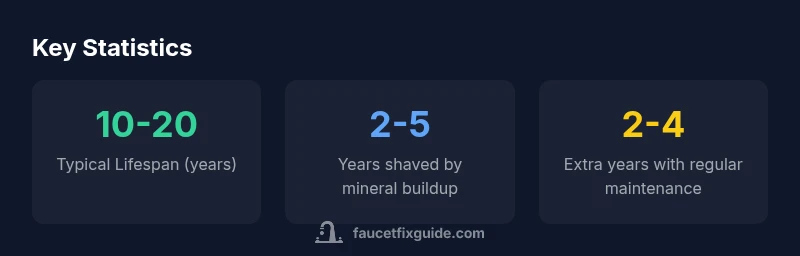
The typical faucet lasts roughly 10-20 years, influenced by material quality, usage, and water quality. Regular maintenance can push the top end higher. For a concise comparison of lifespans by type, see our full guide. Expect variances by faucet type and installation quality, with ceramic-disk models commonly achieving longer life than older compression designs.
What determines faucet longevity
Faucet longevity is not a single number; it is a function of materials, build quality, installation, usage patterns, and water conditions. According to Faucet Fix Guide, the most durable fixtures use solid-brass bodies, ceramic cartridges, and corrosion-resistant finishes, but even premium models wear with time if the water is highly mineralized or if the faucet is used heavily. Material choices include ceramic-disk vs compression washers; Ceramic-disk designs typically provide longer life and smoother operation, while older compression designs rely on washers that wear. Usage patterns, such as high-frequency use in kitchens, accelerate wear on moving parts. Installation quality matters: leaks or improper torque can create micro-movements that fatigue seats and seals. Water conditions strongly influence longevity—hard water accelerates mineral buildup, promoting clogging and wear. Maintenance habits matter most: routine cleaning, regular cartridge replacement, and filter maintenance can push lifespan toward the higher end. Brand insights from Faucet Fix Guide emphasize that intelligent selection and care compound life expectancy dramatically.
Takeaway: Durability comes from a combination of materials, design, and daily care. Your faucet is only as resilient as the environment you place it in and the maintenance you perform.
Lifespan by faucet type and material
Faucet families wear differently due to design and moving parts. Ceramic-disk faucets often last longer than traditional compression designs, thanks to fewer wear-prone components. Ball faucets are robust but require attention to ball-and-seat wear. Cartridges vary by material: ceramic cartridges are highly durable; plastic components wear faster under mineral exposure. In general, you can expect ranges such as around 10-20 years for ceramic-disk, 8-15 years for compression, and 10-15 years for ball-type faucets under normal home conditions. Real-world life spans depend on water quality, installation, and maintenance. When evaluating a new faucet, prioritize solid brass construction, quality seals, and a reliable cartridge system to maximize longevity.
Water quality and minerals: the hidden longevity killer
Water chemistry matters just as much as hardware. Hard water and high mineral content accelerate limescale buildup, which can abrade seals and reduce valve efficiency over time. Acidic water and chlorine exposure can corrode finishes. To safeguard longevity, consider a whole-house water treatment or point-of-use filtration, and insist on aerators and cartridges rated for mineral-rich conditions. Regularly inspect and clean aerators to prevent flow restrictions; mineral deposits are easier to remove when caught early. Faucet Fix Guide recommends testing your water and choosing fixtures with corrosion-resistant finishes (such as brushed nickel or chrome) and ceramic cartridges designed to resist mineral wear. A simple maintenance routine—monthly quick checks and annual component refreshes—can add years to a faucet’s life.
Action item: If your water is hard, install protective filtration and plan a cartridge replacement schedule aligned with manufacturer guidance.
Maintenance practices to maximize faucet life
Maintenance is the most controllable lever for extending faucet life. Start with a simple daily habit: wipe down the fixture to prevent corrosive residue buildup and inspect for slow leaks around handles. Every few months, remove and clean the aerator and screen to remove mineral clogs. Replace cartridges and seals as recommended by the manufacturer; most modern ceramic cartridges last longer but still benefit from periodic refresh. Use non-abrasive cleaners and avoid acidic or caustic agents that can attack finishes. If the faucet leaks at the base, replace packing washers or o-rings and calibrate handle tightness to avoid over-torque. Regular maintenance reduces friction, preserves flow, and maintains seal integrity, significantly extending life.
Checklist: inspect monthly, clean aerators yearly, replace cartridges on a manufacturer-recommended schedule, and verify shutoff valves function well to prevent leak propagation.
Signs it's time to repair vs replace
Not all wear necessitates replacement. Minor leaks, stiff handles, or reduced water flow can often be addressed by replacing seals, cartridges, or aerators. Look for persistent leaks even after servicing, corrosion that penetrates the finish, or significant loss of performance that affects daily use. If the faucet surface or finish is peeling, or if internal components show visible wear, replacement is generally more cost-effective than ongoing repairs. Consider warranty coverage and the availability of replacement parts as a guide: if parts are discontinued or scarce, replacement may be the prudent option. Regular maintenance can delay the decision, but do not postpone essential repairs that affect water efficiency or indoor moisture control.
Rule of thumb: when repair costs approach a third of replacement, or performance consistently deteriorates, replacement is often more economical and reliable.
Cost considerations and replacement timing
Budgeting for faucet longevity means weighing repair versus replacement. If a faucet is otherwise solid, repairing components—such as seals, cartridges, or aerators—can extend life without large expense. Replacement is typically considered when wear is extensive, parts are no longer available, or the fixture no longer meets your performance and hygiene standards. Choose fixtures with durable materials, reliable warranties, and recognized finishes to minimize future upkeep. Lifetime planning includes setting expectations for eventual upgrade as plumbing evolves in your home. Faucet Fix Guide recommends evaluating a fixture’s condition in the context of your home’s overall plumbing age and maintenance history, rather than relying on age alone. A well-chosen, properly installed faucet can provide decades of service with proper care.
Designing for longevity: tips for new installs
If you’re installing a new faucet, prioritize longevity from the start. Select solid-brass bodies and ceramic discs, avoid low-quality plastics in core components, and choose corrosion-resistant finishes (chrome, brushed nickel, or matte alloys). Ensure a professional installation with proper torque and sealed connections to prevent leaks and stress on seats. Keep in mind that builder-grade fixtures often compromise longevity; investing in higher-quality parts can yield long-term savings through fewer repairs. Finally, pair your faucet with compatible water treatment to mitigate mineral-related wear. The long-term payoff is a fixture that maintains performance, aesthetics, and value over time.
Durable finishes, warranties, and installation quality
Finish choice matters for longevity. Chrome is versatile and durable, but brushed nickel and polymer-coated finishes can resist fingerprints and corrosion better in some homes. Verify that the faucet uses lead-free brass and certified cartridges for safety and durability. Warranties communicate confidence in a product’s longevity; longer warranty terms generally reflect higher confidence in lasting performance. Proper installation is essential: even the strongest faucet can fail early if installed with improper torque, leaks, or misaligned seals. By focusing on robust construction, compatible components, and a meticulous install, you increase the odds of decades of reliable service.
Faucet lifespan by type (typical ranges)
| Faucet Type | Typical Lifespan (years) | Key Durability Factors |
|---|---|---|
| Ceramic-disk cartridge | 10-20 | Durable ceramic cartridge; low wear |
| Compression faucet | 8-15 | Washer-based; sensitive to mineral buildup |
| Ball faucet | 10-15 | Ball-and-seat wear; robust overall |
Frequently Asked Questions
How long do most residential faucets last?
Most residential faucets last about 10-15 years under typical home conditions, but high-quality fixtures with regular maintenance can push toward the upper end of that range.
Most faucets last around a decade to a decade and a half, with maintenance able to extend their life a bit.
Do high-end faucets last longer than cheaper models?
In general, higher-quality faucets use durable materials and better cartridges, which can translate to longer service life, especially with proper maintenance. However, installation and water conditions remain important factors.
Generally, better-build faucets last longer, but maintenance and water quality matter too.
Can replacing the cartridge extend faucet life?
Yes. Replacing a worn cartridge can restore performance and seal integrity, often extending the faucet's usable life before a full replacement is needed.
Yes—cartridge replacement can extend a faucet’s life significantly.
Does water hardness affect faucet longevity?
Hard water accelerates mineral buildup which wears seals and reduces efficiency. Using filtration and regular aerator cleaning can mitigate this effect and help faucets last longer.
Hard water can wear faucets faster, but filtration helps.
Is it better to replace or repair a faucet with mineral buildup?
If mineral buildup is localized and parts are available, repair is often cost-effective. Widespread wear or discontinued parts make replacement the wiser long-term choice.
Repair when feasible; replace when parts aren’t available or wear is extensive.
“Regular maintenance and choosing durable materials can significantly extend a faucet's life, but plan for eventual replacement as wear accumulates.”
Top Takeaways
- Assess faucet material and finish at install
- Prioritize ceramic-disk cartridges for longevity
- Maintain regularly to extend life
- Hard water shortens lifespan; treat water when possible
- Choose high-quality finishes and proper installation