What Size Faucet Supply Line: A Practical Guide
Discover the right faucet supply line size for kitchens and baths with practical sizing guidance, common sizes, and step-by-step installation tips to prevent leaks.


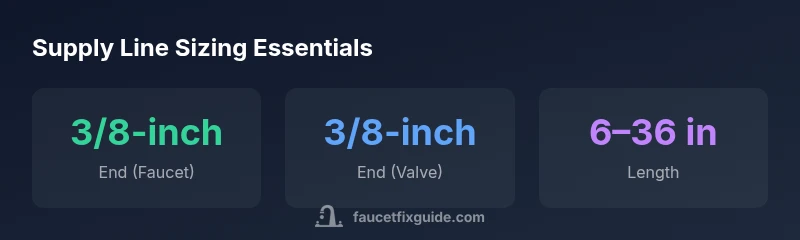
Most modern homes use a 3/8-inch compression faucet supply line on both ends, connecting the shut-off valve to the faucet. Some older setups use 1/2-inch compression on at least one end. The standard length varies, but common lines run 6–24 inches. Always verify by measuring the valve outlet and faucet inlet before buying.
Understanding common sizes
If you're wondering what size faucet supply line you need, you're in the right place. For most residential fixtures, the answer starts with the two standard end fittings: a 3/8-inch compression connection on the faucet side and another 3/8-inch compression on the shut-off valve. This configuration is the industry standard for many modern kitchens and bathrooms, simplifying replacement and reducing leaks. While 3/8-inch compression dominates, you will still encounter older or specialty setups that use 1/2-inch compression on one or both ends. The key to choosing correctly is to verify both ends before buying and ensure the line's length matches the distance between valve and faucet with some slack for operation. In this guide, we'll unpack the sizing landscape and give practical steps to identify your exact size at home.
How to measure your current supply line size
To identify the correct size without guessing, start by turning off the water at the shut-off valve under the sink and placing a towel to catch any drips. Remove the old supply line and measure the nut diameters with a ruler or caliper. If you don’t want to remove it, you can also compare the nut width against standard sizes found at most hardware stores. Check the faucet inlet and the valve outlet: the former will accept a compression nut of a specific size, while the valve outlet will be stamped or labeled with its measurement. Always measure both ends to avoid buying the wrong line. If you’re unsure, bring the old line to the store or take a photo for reference.
3/8-inch compression: the standard choice
The 3/8-inch compression end is the most common on both faucet sides for modern fixtures. This sizing provides a good balance of flow and sealing capability when paired with compatible shut-off valves. If your faucet or valve shows a 3/8-inch marking, a 3/8-inch compression supply line is typically the right match. When you buy, look for lines labeled as 3/8-inch compression on both ends or a dual-end line described as 3/8 by 3/8. These lines are widely available in braided stainless steel and vinyl-coated variants, offering durability and a flexible fit.
When to consider 1/2-inch compression lines
A 1/2-inch compression line is less common for residential sinks but can appear in older homes or specific fixtures. If your valve outlet or faucet inlet is 1/2-inch, you’ll need a matching line with 1/2-inch compression on the end that connects to the valve and a compatible end for the faucet. If you’re replacing in a mixed-age installation, you may find a line with different end sizes (for example, 3/8-inch on the faucet end and 1/2-inch on the valve end). In such cases, adapters exist, but the simplest solution is to use a line that matches both ends.
How to choose the correct length
Supply line length matters for proper operation and aesthetics. Measure the distance from the valve outlet to the faucet inlet, then add a few inches for maneuverability and future maintenance. Common lengths range from short 6 inches to longer 24–36 inches, with extra length acceptable if it’s not kink-prone. Flexible braided lines can bend comfortably around cabinets, while rigid lines save space in tight setups. If you’re unsure, choose a length on the longer side and secure any excess with clips or wraps, ensuring the line won’t snag or stretch during use.
Materials and durability: braided stainless vs plastic-coated
Braided stainless steel supply lines are popular due to superior durability, kink resistance, and abrasion resistance. They resist corrosion and maintain flexibility over time. Plastic-coated lines tend to be cheaper and lighter but can wear faster under heavy use or sharp edges. When selecting, prioritize lead-free materials and fittings, check for compatible nut sizes, and consider the environment (hot water exposure, mineral-rich water) that may affect longevity. For most homes, braided stainless steel offers a longer service life with a cleaner look under the sink.
Compatibility tips for kitchen vs bathroom faucets
Kitchen faucets often require longer supply lines due to deeper sinks and more cabinet space, while bathroom fixtures usually sit closer to shut-off valves. Always verify the faucet’s inlet size and consider the routing path behind the sink. If you’re replacing fixtures, bring both the faucet and valve measurements to the store, as compatibility depends on ends and threading, not just length. In mixed setups, you may need a dual-end line or an adapter kit to ensure a secure seal at both ends.
Installation steps to replace a faucet supply line
Before starting, turn off the main water supply and place towels to catch spills. Relieve any pressure by opening the faucet to drain residual water. Use a wrench to loosen the nuts on the old line, being careful not to twist the valve stem. Lubricate new compression nuts with a little plumber’s soap or silicone grease, then thread the new line onto the faucet and valve by hand while holding the connector steady. Finish with a wrench, being careful not to overtighten. Turn the water back on slowly and check for leaks at both ends. If you see moisture, tighten slightly, but never force the connection.
Troubleshooting leaks and signs of wrong size
Leaks at the connections typically indicate an incorrect size, cross-threading, or a loose nut. If a leak persists after tightening, inspect the ferrule and washer for damage and ensure the line isn’t bending sharply. A line that’s too long can sag and trap moisture, while a line that’s too short can add stress on fittings and cause leaks over time. If you’re hearing a hissing sound or seeing damp cabinets after running the faucet, recheck the size compatibility and consider replacing with the correct end sizes or a sturdier braided line.
Common faucet supply line size options and lengths
| End connection faucet | End connection valve | Common use case | Typical length |
|---|---|---|---|
| 3/8-inch compression | 3/8-inch compression | Modern kitchens and baths | 6–24 inches |
| 3/8-inch compression | 1/2-inch compression | Hybrid setups with older valves | 6–24 inches |
| 1/2-inch compression | 1/2-inch compression | Older fixtures | 12–36 inches |
Frequently Asked Questions
What is the most common faucet supply line size?
The most common size for residential sinks is 3/8-inch compression on both ends, compatible with standard shut-off valves and faucet inlets.
Most homes use 3/8-inch compression lines on both ends.
Do kitchen faucets require different lines than bathroom faucets?
In most cases, both require 3/8-inch compression lines, but always verify the faucet inlet and valve outlet specs before purchase.
Typically the same size, but verify your specs.
Can I use any length of supply line?
Length should suit the distance between valve and faucet with a little extra for maneuverability. Avoid excessive slack that can sag or kink.
Measure the distance and add a bit for slack.
What if my valve has a different size than the faucet?
Use a line with matching ends or add an adapter kit. Flexible lines with dual-end fittings are common solutions.
Use the right ends or an adapter.
Are braided stainless lines better than plastic-coated?
Braided stainless lines generally offer greater durability and kink resistance; plastic-coated lines are cheaper but wear faster.
Braided is usually more durable.
“Sizing a faucet supply line correctly is the simplest step to prevent leaks and service calls. Match valve outlet to faucet inlet, then select a length that leaves gentle slack for operation.”
Top Takeaways
- Identify both ends before buying to avoid misfit.
- 3/8-inch compression is the dominant size for modern fixtures.
- Measure length with some slack for movement.
- Choose braided stainless steel for durability.
- Use adapters only when necessary to preserve seal integrity.