When Tap to Pay Started in Canada: A 2026 Timeline
Explore the timeline of tap to pay in Canada, from early pilots in the late 2000s to widespread adoption across retailers and mobile wallets in the 2010s, with security basics and practical DIY tips.


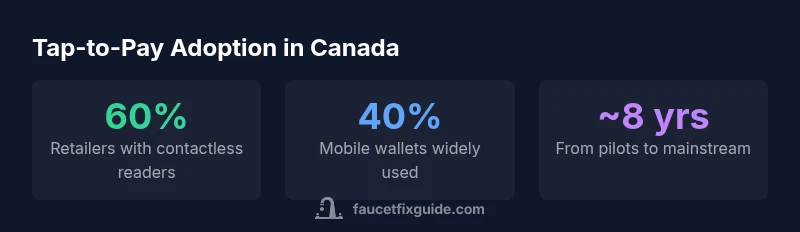
Tap to pay in Canada began with pilots in the late 2000s, expanding through the early to mid-2010s as Interac Flash and card networks broadened support. By the mid-2010s, a majority of major retailers had welcome contactless payments, with mobile wallets further accelerating adoption. Widespread checkout availability continues to grow as devices and readers become more capable across the country.
Why tap-to-pay matters in Canada
When you ask when did tap to pay start in canada, you're asking about how contactless technology moved from niche pilots to everyday checkout. In Canada, this shift began with early pilots that tested near-field communication between cards and readers, gradually expanding as networks built support and consumer devices became common. For homeowners and renters, understanding this timeline helps you avoid buying the wrong wallet, device, or reader when upgrading your home payments. According to Faucet Fix Guide, watching these milestones informs DIY decisions about upgrading your home payments ecosystem. The timeline also intersects with questions of security, privacy, and simplicity that matter for families and households. Over the past decade, retailers across cities and provinces rolled out contactless terminals; mainstream acceptance followed as Interac Flash, Visa payWave, and Mastercard PayPass reached a tipping point. In practice, you’ll find tap-to-pay options on most grocery, transit, and big-box retailers today.
How NFC payments work in plain terms
Tap-to-pay relies on near-field communication (NFC) to exchange payment data between a card, a phone, or another device and a reader at close range. Instead of swiping or inserting a card, you simply hold your device within a few centimeters of the reader. Behind the scenes, a tokenized transaction is created so merchants never see your actual card number. This approach reduces data exposure and speeds up checkout for households and DIY enthusiasts who value convenience. Wallet apps, banks, and card networks cooperate to keep the system interoperable across brands and devices. For readers and phones, the key compatibility marker is NFC capability and secure element storage, which enables safe, contactless payments at most retailers in Canada today.
Timeline overview: when did tap to pay start in canada
The question of when tap to pay started in canada is best understood as a multi-phase timeline rather than a single year. In the late 2000s, pilot programs tested NFC between cards and readers in select stores and transit systems. As the technology matured, networks like Interac Flash expanded the ecosystem. By the early to mid-2010s, major card networks including Visa and Mastercard rolled out contactless support broadly, and more retailers began accepting tap-to-pay at checkout. Since the mid-2010s, adoption has accelerated, especially with mobile wallets (such as Apple Pay and Google Pay) that piggyback on existing card networks. The exact year varies by province and retailer, but the overall arc shows progressive mainstreaming across urban and rural areas alike. In short, the timeline moved from pilot programs to nationwide acceptance over roughly a decade.
Regional differences in adoption across Canada
Canada's adoption curve for tap-to-pay did not unfold uniformly. Urban centers like Toronto, Vancouver, and Montreal saw faster deployment due to higher transaction volumes and more tech-savvy consumers, while some rural regions lagged behind in card-reader upgrades. Provincial initiatives and retailer mix influenced the pace, with transit systems and big-box retailers often leading the charge. Cash remains common in certain pockets, but the trajectory has been toward making tap-to-pay a default option at checkout. For DIY homeowners planning upgrades, this regional variance means you may see different equipment requirements by location, and some municipalities may emphasize transit tap-to-pay integration more than others.
Consumer experience and device compatibility
Most smartphones and many cards now support tap-to-pay, making it accessible for a wide audience. If your device is NFC-enabled, you can add a supported wallet app and start paying at compatible readers. For households, this simplifies small purchases like groceries, coffee, and transit fares. However, device compatibility, reader updates, and merchant acceptance vary by vendor, so it helps to verify with your local retailers. In Canada, ongoing improvements in payment networks continue to expand the number of places where you can tap to pay, including some smaller retailers and regional stores.
Security and privacy basics
Tap-to-pay uses tokenization and dynamic cryptograms to keep card numbers private during transactions. The risk of contactless misuse has decreased as technology matured, but it remains wise to enable device-level lock screens and keep software up to date. For households, this means adding an extra layer of security while maintaining convenience. If a phone or card is lost, you can suspend or remove the wallet from the device settings. For large purchases, many wallets still require an additional step, such as a PIN or biometric verification, to safeguard against accidental taps.
Practical steps for readers upgrading home payments
- Check device compatibility: ensure your phone, smartwatch, or card is NFC-enabled and supports a trusted wallet.
- Verify merchant acceptance in your area: look for contactless logos at checkout.
- Update readers if you own a small business or hand-me-down equipment: many old terminals still work, but newer readers can handle faster transactions and better security.
- Consider budgeting for a wallet upgrade or an affordable reader: small changes can enable faster, safer transactions for visitors and guests.
- Test payments with small amounts before relying on contactless for daily use to avoid surprises.
These steps help homeowners and DIY enthusiasts implement tap-to-pay features confidently, especially as the Canadian market continues to embrace contactless payments. When you plan upgrades, consult your device manual and merchant partners to ensure smooth operation.
The future outlook for tap-to-pay in Canada
Looking ahead, tap-to-pay is expected to become even more ubiquitous as readers, wallets, and devices converge toward universal support. The ongoing push toward seamless checkout, public transit integrations, and grocery supply-chain applications will likely keep broad adoption momentum. For households, this means ongoing opportunities to streamline payments, reduce friction at checkout, and take advantage of enhanced security features that accompany next-generation tokenization and risk controls. The evolution will likely unfold at a pace shaped by consumer demand, merchant readiness, and regulatory updates that keep payments secure while preserving privacy. In sum, the trajectory points toward a cashless footing for everyday purchases with continued innovation across networks and devices.
Common myths about tap-to-pay in Canada
- Myth: Tap-to-pay is only for smartphones. Truth: Many cards and wearables support contactless payments.
- Myth: It is less secure than traditional cards. Truth: Tokenization and dynamic cryptograms help protect data.
- Myth: It always requires an internet connection. Truth: Most transactions are processed offline first; online verification occurs afterward.
- Myth: It’s not accepted everywhere. Truth: Acceptance is widespread at major retailers, groceries, transit, and small businesses in many urban areas.
- Myth: It will replace all cash immediately. Truth: Cash remains part of consumer behavior, while tap-to-pay forms are increasingly common.
Timeline phases for tap-to-pay adoption in Canada
| Phase | Approx Year Range | Key Milestones |
|---|---|---|
| Pilot phase | 2007-2010 | NFC testing with select retailers and transit systems |
| Widespread rollout | 2011-2016 | Interac Flash and card networks expand; more merchants adopt |
Frequently Asked Questions
What is tap-to-pay and how does it work?
Tap-to-pay is a contactless payment method that uses NFC to exchange payment credentials between a device (card or smartphone) and a reader. Transactions are tokenized for security and typically require no physical contact beyond placing the device near the reader.
Tap-to-pay uses NFC to pay with a card or phone, with tokenization for security.
When did tap-to-pay first appear in Canada?
Early pilots appeared in the late 2000s, with broader adoption by the early-to-mid 2010s as Interac Flash and major card networks expanded support.
It started with pilots in the late 2000s and expanded in the early-to-mid 2010s.
Which networks supported tap-to-pay in Canada?
Interac Flash, Visa payWave, and Mastercard PayPass were early adopters, with continued expansion across wallets and devices.
Interac, Visa, and Mastercard supported it, with broader wallet support later.
Is tap-to-pay still expanding in Canada?
Yes, adoption continues to grow as more devices, wallets, and retailers embrace contactless payments.
Yes, it’s still expanding to more devices and stores.
Are there security concerns with tap-to-pay?
Security features like tokenization and risk controls reduce exposure, but users should keep devices updated and use PINs/biometrics for added protection.
Security is strong due to tokenization, but stay vigilant with updates and PINs.
“Tap-to-pay timelines illustrate how technology diffusion moves from pilot tests to mainstream use as networks, devices, and merchants align.”
Top Takeaways
- Learn the late-2000s onset of tap-to-pay pilots in Canada
- Recognize the 2010s as the era of broad rollout by major networks
- Expect regional differences in adoption pace
- Know that security features like tokenization underpin safety
- Plan upgrades with an eye on merchant acceptance and device compatibility
- Tap-to-pay is increasingly common, but cash still plays a role