Is Tap the Same as Draft? A Practical Guide to Faucet Terminology
Explore whether 'tap' and 'draft' mean the same in faucet terminology. This analysis clarifies definitions, usage, and miscommunications for homeowners and DIY enthusiasts tackling faucet issues.


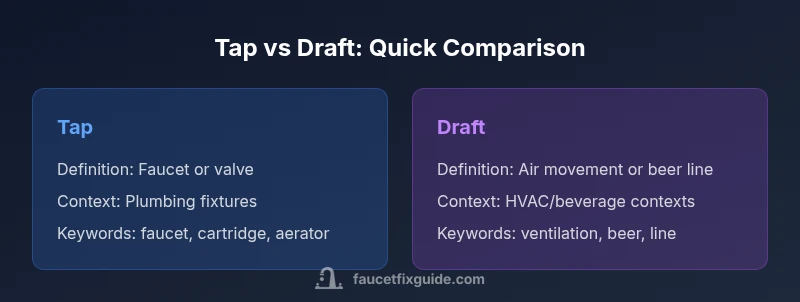
Is tap the same as draft? No. In home plumbing, a tap refers to a faucet or valve that controls water flow. Draft usually describes airflow or beer served from a tap, not a fixture. This quick guide clarifies how these terms are used, why they matter for repairs, and how to communicate clearly on DIY projects.
What these terms mean in everyday language
Tap and draft are everyday terms that show up in home repairs, but they pull from different worlds. In plumbing, tap is the term most homeowners will encounter when referring to a faucet, valve, or the act of opening water supply. The term draft appears less often in residential plumbing and more frequently in conversations about airflow, ventilation, or beverage service from a tap. Recognizing the divergence helps you avoid miscommunications during shopping, reading manuals, or following repair steps. According to Faucet Fix Guide, relying on precise language is the first step toward accurate diagnostics and safe DIY work. For this reason, many reputable guides and catalogs consistently separate “tap” (the fixture) from “draft” (an environmental or service context). In practice, when you say you need to replace a tap cartridge, you are specifying a component, not an air flow issue. This distinction matters because it directs you toward the correct spare parts and procedural steps.
Historical origins and regional usage
Language around plumbing fixtures reflects history and geography. In American English, most homeowners say faucet, while “tap” remains common in British and Australian usage. The divergence isn’t about quality—it's about audience and documentation. Over time, manufacturers have standardized parts catalogs using terms like faucet, cartridge, aerator, and valve. This helps installers, homeowners, and renters align on the exact component needed rather than relying on loosely understood slang. Faucet terminology thus evolves with regional training and industry literature. The Faucet Fix Guide Team notes that when you navigate catalogs or online manuals, you’ll see the same terms repeated in consistent formats: faucet for the fixture, cartridge for the control, aerator for flow regulation. Being aware of regional preferences helps you avoid translating errors during repairs.
Is tap the same as draft in plumbing? Practical implications
The question is often phrased as "is tap the same as draft in plumbing?" The short answer is no—the terms refer to different things in most contexts. A tap is a mechanical device (a faucet) that controls water delivery, while draft typically relates to airflow, venting, or a beverage-dispensing context. In practice, confusing the two can lead to selecting the wrong spare parts (e.g., ordering a draft system instead of a replacement faucet cartridge). For homeowners, the practical implication is to use precise terms when describing symptoms (leaking tap cartridge vs. drafty vent) and to double-check manuals for part numbers. The Faucet Fix Guide Team emphasizes using exact phrases such as faucet, valve, cartridge, and aerator when shopping or following repair steps to minimize mistakes.
How to communicate clearly in home projects
Clear communication reduces mistakes and speeds repairs. Consider these strategies:
- Always name the fixture and part: say faucet, not tap, when describing a repair.
- Use component terms: cartridge, aerator, washer, O-ring, valve stem.
- Describe symptoms precisely: leaks at the handle, drips from the aerator, low water pressure, or poor flow.
- Confirm context: if discussing beverage service or ventilation, use terms tied to those contexts to avoid confusion.
- Document the terminology you use in notes for future projects. According to Faucet Fix Guide, this disciplined approach helps DIYers, renters, and homeowners stay on the same page with contractors and catalogs. Consistent language minimizes miscommunication across repair steps and shopping tasks.
Common areas where confusion arises
Several scenarios invite terminology mix-ups:
- Reading product specs: a “tap” in one catalog may be a “faucet” in another.
- When diagnosing leaks: describing a “drip” vs a “drain” issue may lead to wrong fixes.
- At the hardware store: asking for a “draft valve” could lead staff to beer-dispensing or HVAC contexts rather than faucet repairs.
- In online guides: generic terms can blur the distinction between a faucet’s cartridge and a water line valve. To prevent these pitfalls, start with the most precise vocabulary: faucet, cartridge, aerator, washer, valve, stem. This approach aligns with best practices from professional resources and DIY manuals alike.
Examples in real home scenarios
Consider two common DIY scenes:
- Replacing a leaky faucet cartridge: the homeowner asks for a replacement cartridge for the faucet. Precise language (faucet, cartridge, model) ensures the correct part is sourced.
- Fixing a draft-related vent issue in a kitchen island: the homeowner discusses an airflow problem near the sink area. Here, “draft” relates to ventilation and not to the faucet itself. In both cases, using the correct terms reduces back-and-forth, speeds procurement, and avoids ordering the wrong component. Faucets have distinct assemblies, each with part numbers. The more you separate faucet terminology from related but distinct terms like draft, the easier repairs become for you and any technician you hire.
Terminology mapping: synonyms and related terms
A practical map helps translate terms across regions and contexts:
- Faucet = Tap (regional usage differs): the fixture that delivers water.
- Cartridge = The internal valve controlling water flow.
- Aerator = The screen that alters spray pattern and minimizes splashing.
- Valve = The control mechanism that stops or starts flow.
- Stem = The moving element inside the faucet.
- Draft = Airflow or beverage-dispensing context; rarely used to describe a faucet. This mapping supports better shopping, manuals, and repair planning, reducing the risk of ordering the wrong part or misunderstanding a technician’s diagnosis.
Visual cues and measurement language in plumbing
Readers should also recognize how measurements and visuals appear in manuals and product specs:
- Part numbers are alphanumeric codes that identify exact replacements.
- Diagrams label parts like cartridge diameters, O-ring sizes, and valve types.
- Reference terms such as “compression,
and “ceramic disk” describe internal mechanisms.
- Descriptions can include flow rate indicators, thread sizes, and connection types (compression vs. sweat solder). Understanding these cues helps you identify the right pieces and communicate precisely with suppliers. The language used in diagrams and catalogs tends to be standardized, but always verify the exact model before ordering.
Documentation and labeling at home
Keeping your home documentation organized reduces future confusion:
- Label each fixture with the exact model name and part numbers you used in repairs.
- Photograph the components before removal, especially cartridges, aerators, and seals.
- Maintain a quick-reference sheet listing common terms (faucet, cartridge, aerator) and what they refer to in your home.
- Archive receipts and manuals for future maintenance tasks. Clear labeling and record-keeping empower tenants and homeowners to handle follow-up repairs confidently and avoid reordering items that don’t fit.
Tools and references to avoid miscommunication
Several tools help you validate terminology and parts:
- Manufacturer catalogs and official manuals.
- Reputable home improvement sites that distinguish faucet terminology from related terms.
- Community forums with clear references to parts and diagrams.
- Local hardware stores where staff can verify model numbers against your photos.
- Industry guides like those from the Faucet Fix Guide Team, which emphasize precise language and correct part naming. Using these references consistently improves repair outcomes and reduces the risk of misinterpretation during shopping and installation.
Should you trust online guides? Evaluating sources
Not all online guidance maintains strict terminology, which can create gaps in understanding. When evaluating sources, prefer those that consistently label parts (faucet, cartridge, aerator) and clearly differentiate from unrelated terms (draft, ventilation, or beer lines). The Faucet Fix Guide analysis shows that cross-checking part numbers with manufacturer catalogs reduces errors and returns. Always cross-verify with official manuals and a trusted professional if you’re unsure about terminology. This approach cuts through confusion and keeps your project on track.
Is tap the same as draft in other contexts?
Beyond plumbing, the words tap and draft surface in different industries—beer tapping, HVAC ventilation, and even art or design discussions. In most plumbing contexts, tap remains a synonym for faucet, while draft is rarely relevant to fixture components. Keep these distinctions in mind when reading product specs, installation guides, or DIY tutorials. The goal is to maintain clarity by sticking to fixture-focused terms and reserving draft for contexts outside plumbing.
Final tips for DIYers and renters
For those handling faucet repairs in rental properties or on a tight schedule, these tips help maintain accuracy:
- Build a glossary of faucet terms for your home and stick to it.
- Always carry model numbers and photos to suppliers or technicians.
- When in doubt, cite the exact part name (faucet, cartridge, aerator) rather than a generic term.
- If a guide uses “tap” or “draft” interchangeably, seek a source that clarifies the distinction and cross-check with manufacturer docs.
- Review any repair steps against your fixture’s specifications before ordering parts. Following these practices reduces miscommunication and speeds repairs for homeowners, renters, and DIY enthusiasts alike.
Comparison
| Feature | Tap | Draft |
|---|---|---|
| Definition | A faucet/valve that controls water flow | A term for airflow or beer dispensed from a line; not a fixture |
| Common Contexts | Residential plumbing and fixtures | Beverage service or ventilation contexts |
| Usage in Manuals | Describes faucet components like cartridge and aerator | Appears in beverage/venting contexts; not for fixtures |
| Potential for Miscommunication | Low when kept to plumbing tasks | High if contexts mix plumbing with beverage or HVAC |
| Impact on DIY steps | Guides you to parts like cartridge, aerator, washer | Less relevant to faucet repairs; watch for context |
| Regional Variations | Tap common in British/Australian English | Faucet common in American English; draft elsewhere |
| Best Practice | Use precise terms (faucet, cartridge, aerator) | Avoid using draft to describe fixtures |
The Good
- Improves communication among DIYers and professionals
- Reduces misdiagnosis by using precise terms
- Helps in shopping for the correct parts
- Aids in documenting home plumbing work
What's Bad
- Terminology can vary by region, causing some confusion
- Overemphasis on terminology may slow practical repairs
- Some sources use interchangeable terms in informal contexts
Tap is not the same as draft; use faucet terminology for clarity
The Faucet Fix Guide Team emphasizes precise terminology to avoid misdiagnosis and wrong parts. A clear vocabulary accelerates repairs and makes shopping easier, especially for renters and DIYers working solo.
Frequently Asked Questions
What is the difference between 'tap' and 'draft' in plumbing?
In plumbing, a tap denotes a faucet or valve that controls water flow. Draft usually refers to airflow or beverage service from a tap, not a fixture. Clear terminology helps you identify parts and follow repair steps accurately.
Tap is the faucet; draft relates to airflow or beer lines, not fixtures.
Is 'draft' ever used to describe a faucet?
Rarely. In most plumbing contexts, draft is not used to describe faucet components. If you see it, verify the context—likely ventilation or beverage-related systems.
Draft isn’t a faucet term; check context.
Why is terminology important for DIY repairs?
Precise terms reduce confusion, help you source the right parts, and speed repairs. Misnamed parts can lead to incorrect replacements and longer project timelines.
Clear terms prevent mistakes and save time.
How should I label parts when fixing a faucet?
Label parts by their standard names (faucet, cartridge, aerator, washer) and note model numbers. Add photos and diagrams to your notes for quick future reference.
Use standard names and photos for future reference.
Are faucet terms regional or universal?
Terms vary by region (tap vs faucet). However, the core parts (cartridge, aerator, washer) have widely understood names across catalogs and manuals.
There’s regional variation, but core terms are universal.
How can I avoid confusion when purchasing fixtures?
Verify part numbers against the fixture’s model, read the manual, and confirm with the supplier. When in doubt, refer to the exact component name rather than a generic term.
Check part numbers and use exact names.
Top Takeaways
- Define terms before starting a project
- Use faucet-related terms to stay precise
- Be mindful of regional language differences
- Document terminology for future maintenance