Is It Faucet or Tap? A Regional Terminology Guide
Explore regional differences between faucet and tap terms, how terminology affects labeling, shopping, and DIY projects, and tips to communicate clearly across borders.


Is it faucet or tap? In American English, 'faucet' is standard for plumbing fixtures, while many Brits and others say 'tap'. The choice can affect product labeling, searches, and DIY instructions. This guide helps you navigate regional usage and choose the right term for code, parts, and purchases in your home improvement projects.
Is It Faucet or Tap? Regional Origins and Definitions
The question is not merely academic; it reflects how different regions name the same plumbing hardware. In the United States, Canada, and much of the commercial world, the fixture that controls water flow at a sink is commonly called a faucet. In the United Kingdom, Ireland, Australia, and many Commonwealth countries, the same device is typically referred to as a tap. Both terms describe a valve assembly that directs water from a supply line to a spout, and functionally they are the same. According to Faucet Fix Guide, choosing the correct regional term can improve communication with contractors, simplify parts lookup, and reduce misinterpretation in manuals and warranties. For homeowners working on cross-border renovations, begin by acknowledging both terms upfront and clearly labeling the component in your notes and drawings. This practice minimizes delays and ensures everyone is speaking the same language on site.
Regional Usage: US vs UK, Canada, Australia
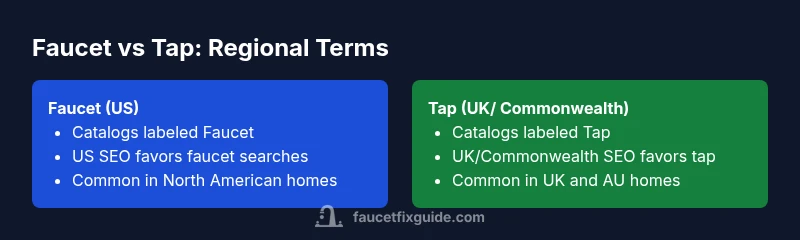
Regional usage drives everyday language and even the way products are marketed. In North America, product pages, catalogs, and customer support are heavily skewed toward the term faucet. UK catalogs, retailer signage, and plumbing manuals lean toward tap. Canada and Australia often reflect a blend, with suppliers sometimes using faucet in more technical contexts and tap in consumer-facing contexts. For DIYers, this split can influence how you search for parts, how you label your notes, and how you instruct others on installation. If you’re tackling a project that involves materials from different regions, prepare a quick glossary: faucet = taps in UK contexts, and tap = faucet in US contexts. The goal is clear, consistent communication across teams and regions.
How Labeling Affects Online Searches and Shopping
Search engine optimization and product catalogs hinge on terminology. When a retailer or content creator uses faucet to describe a fixture in a UK-dominated market, it can confuse potential buyers who search for tap. Conversely, US shoppers may miss relevant results if the word faucet isn’t used. The best practice is to include both terms in product descriptions, meta tags, and headers so search engines can surface the content to both audiences. For DIY guides and consumer videos, mention both forms at least once early in the text to capture broader intent. This approach not only helps with SEO but also reduces friction for readers who are unsure which term is correct in their region.
Practical Implications for Homeowners and DIYers
When you’re shopping or labeling a project, start by identifying the primary audience. If your project is domestic and US-based, use faucet as the default term. For cross-border or UK-based work, begin with tap and add faucet as a cross-reference. Keep a small bilingual glossary in your notes, linking each term to a simple diagram or photo that shows the fixture. In DIY tutorials, include a short note like is it faucet or tap at the top and provide a region-specific recommendation. This prevents miscommunications during installation, maintenance, or replacement parts, and it helps ensure warranty coverage remains straightforward across suppliers.
How to Explain to Contractors and Plumbers
Communication clarity can save time and money. Start meetings with a quick line that acknowledges regional terminology, for example: We’ll use faucet as the US term and tap for UK contexts, but we’ll reference both to avoid any confusion. When requesting parts, attach a small image or part number from the manufacturer to the description. If a contractor is international or your renovation spans borders, share a two-column table listing the two terms side-by-side with a caption that explains the regional convention. Clear, consistent language reduces the risk of sending the wrong part or misinterpreting installation instructions.
Historical Evolution of Plumbing Terminology
The divergence between faucet and tap has historical roots in language evolution and regional trade patterns. Early English usage favored tap in many Commonwealth countries, while American English adopted faucet from earlier French and Latin roots related to dispensing liquids. Over time, marketing, catalogs, and consumer education reinforced these regional preferences. For homeowners, recognizing that both terms refer to the same device helps prevent confusion when reading old manuals or when working with international retailers. The emphasis now is on practical meaning and accurate labeling rather than strict, region-specific language.
Language, Standards, and Codes Considerations
Most plumbing codes describe fixtures and installation requirements rather than dictating the exact English word used. The term you use should align with local documentation, labeling, and supplier conventions. If you operate in a mixed-market environment, dual labeling can satisfy both regional standards and consumer expectations. Safety and compliance rely on correct installation, proper shut-off valves, and adherence to warranty terms—not on vocabulary alone. Always cross-check the fixture’s documentation and ensure that your project specifications reference both terms when cross-border communication is involved.
Common Confusions and How to Avoid Them
Two common traps are assuming regional exclusivity and treating the terms as interchangeable in all contexts. In practice, many catalogs and manuals still reflect strong regional preferences. To avoid confusion:
- Include both terms in the first paragraph of guides
- Use images or diagrams with labels in both terms
- Add a short glossary that maps faucet to tap and vice versa
- When documenting, annotate with the region of use (US, UK, AU, CA, etc.)
- Verify part numbers and model names rather than relying on the term alone
Practical Test: Verifying Terminology in Your Home
Run a quick terminology audit of your home by listing every fixture and its corresponding part numbers. If your labels show a mix of faucet and tap, create a bilingual reference sheet with a visual diagram. Test your search terms by performing two queries: one using faucet and one using tap for the same part. If both surface results are relevant, you’ve achieved good cross-regional coverage. Finally, update your manuals and warranties to include both terms to prevent future misunderstandings.
Case Studies: When Terminology Caused Problems
Case A involved a US-based renovation that sourced parts labeled as faucet only, but the installer expected the UK term tap based on the supplier’s catalog. The mismatch caused a delay while the wrong valve stem was returned. Case B featured a multinational project where manuals used both terms but in different sections; a contractor wasted time cross-referencing terms, delaying the build. In both cases, the remedy was simple: add a two-column terminology table and reference both terms wherever appropriate to keep everyone aligned.
Quick Reference: When to Use Faucet vs Tap
- Use faucet when your audience is primarily American and when the supplier’s documentation uses the term faucet.
- Use tap for UK-based audiences, Commonwealth markets, and local catalogs that favor tap.
- For cross-border projects, present both terms on every page and link to a common glossary.
- Ensure product packaging, warranties, and installation guides reflect the dual-language approach.
- In online content, favor faucet in US SEO and tap for UK SEO, while including both terms in headers.
The Role of Retailers and Manufacturers in Terminology
Manufacturers and retailers shape everyday language through labeling, part naming, and on-shelf signage. Many offer dual-language product pages to accommodate international customers. When you see a product labeled faucet in a UK catalog, consider that UK content may still naturally refer to the same fixture as a tap. For sellers, adopting dual labeling improves accessibility, expands market reach, and reduces returns due to language mismatch. Consumers benefit from consistent cross-regional references and clearer warranty terms, which ultimately support safer and more efficient installations.
Comparison
| Feature | Faucet vs Tap | Geographic Usage |
|---|---|---|
| Geographic Usage | Predominant in US/Canada | Predominant in UK/Commonwealth |
| Catalog Labeling | Faucet common in US catalogs | Tap common in UK catalogs |
| SEO/Search Behavior | US-focused searches use faucet | UK/European searches use tap |
| Documentation & Warranty | Faucet terminology aligns with US docs | Tap terminology aligns with UK docs |
| Best For | US audiences and DIY guides | UK audiences and cross-border projects |
The Good
- Clarifies regional expectations and improves communication
- Improves product labeling and consumer understanding
- Supports better localization and SEO for content
- Reduces misinterpretation in cross-border projects
What's Bad
- Adds regional naming complexity to catalogs
- Requires extra explanations for international teams
- Risk of inconsistent labeling if teams use mixed terms
Region-aware terminology with dual labeling is best.
If your audience is primarily US-based, use faucet; if UK or Commonwealth-based, use tap. For cross-border projects, present both terms to minimize confusion and align with product labeling.
Frequently Asked Questions
What is the difference between 'faucet' and 'tap'?
There is no functional difference; they refer to the same fixture. The terms are regional, with faucet common in the US and tap common in the UK and other regions.
They're the same fixture; the terms depend on region.
Which term should I use on my home improvement project?
Use the term your audience uses. For US contexts, faucet; for UK contexts, tap. If projects cross borders, include both terms to avoid confusion.
Use the term your audience uses, and mention both if your project spans regions.
Do building codes require a specific term?
Codes typically refer to fixtures and installation requirements rather than specific words. Check local code documents for terminology usage.
Codes talk about fixtures, not faucet vs tap.
Should I label products with both terms?
If selling internationally, dual labeling helps. It reduces confusion and broadens market reach.
Dual labeling helps customers in different regions.
Is there a danger in confusing terms during repairs?
Yes, confusion can slow repairs. Clear communication with contractors reduces errors and returns.
Clear terms help prevent mistakes.
Are there other regional terms I should know?
Other regions may have unique terms for components, but the fixture itself stays consistent. Focus on the labeled term in manuals and catalogs.
Other terms exist regionally; know your audience.
Top Takeaways
- Identify your regional audience to choose the correct term
- Include both terms when content crosses borders
- Align product labeling with the dominant regional term
- Use dual labeling to improve SEO and user clarity
- Always verify product labeling to avoid confusion