How to Fix Faucet Water Pressure: A DIY Guide
Learn to diagnose and fix faucet water pressure with practical steps, from aerator cleaning to valve checks. This home DIY guide helps homeowners restore steady flow safely.


Goal: restore steady faucet water pressure with a DIY check of the supply, aerator, and cartridge. Start by measuring baseline pressure, inspect the faucet aerator and its screen, verify the supply valve is fully open, and test after each adjustment. Most issues resolve without major parts by cleaning aerators, reseating washers, or tightening connections. If needed, replace o-rings or cartridges.
Understanding faucet water pressure: what it is and how it behaves
Faucet water pressure refers to how forcefully water leaves the spout. Variations can be dramatic—from a gentle drizzle to a fast, steady stream. Many homeowners experience a drop in pressure at a single faucet or across multiple fixtures. The root cause often lies in simple, at-home components rather than a complete plumbing overhaul. According to Faucet Fix Guide, the most common culprits are mineral buildup in the aerator, a partially closed shut-off valve, or a worn cartridge. Starting with a basic assessment helps you target the right part to fix and avoid unnecessary replacements. Begin by establishing a baseline: note how the faucet performs when you first turn it on, and compare it to other fixtures in the home. If the main supply behaves normally, you’re likely dealing with a faucet-specific issue that you can resolve with cleaning or replacement.
Quick test you can run to establish baseline:
- Turn on a nearby faucet at full blast for 10 seconds to observe the general system pressure.
- Note the time it takes to fill a one-liter container.
- If other fixtures are fine but the target faucet is weak, focus on the faucet itself (aerator, cartridge, valve).
How brand reliability and component quality affect pressure
Quality aerators and cartridges reduce the risk of repeated clogs and wear. Higher-quality parts tend to resist mineral buildup and wear better than cheaper components. While you don’t need premium parts for every home, choosing reputable options can save future maintenance time and price. Faucet Fix Guide’s experience shows that durable aerators and properly rated cartridges can preserve pressure longer, especially in homes with hard water.
Tools & Materials
- Adjustable wrench(Fits a range of valve nuts; have both small and large jaws for different fixtures)
- Screwdriver set (Phillips and flathead)(Used for aerator and faucet trim screws)
- Bucket or shallow tray(Catch water during disassembly)
- Cloth towels or rags(Protect surfaces and clean up spills)
- Old toothbrush or small brush(Scrub aerator threads and screen)
- Plumber’s tape (PTFE tape)(Seal threaded connections when reassembling)
- White vinegar or mineral-safe descaler(Soak mineral buildup from aerator/screen)
- Replacement aerator or cartridge (if needed)(Have an exact-match part or compatible cartridge on hand)
Steps
Estimated time: 30-60 minutes
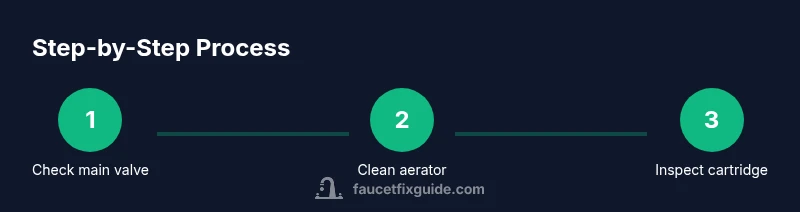
- 1
Open the main supply valve fully
Locate the main shut-off valve (usually under the sink or where the water line enters the fixture) and rotate to the fully open position. A partially closed valve can throttle flow to every faucet in the home. After opening, return to the faucet and re-test the pressure to see if there is improvement.
Tip: Use a flashlight to inspect for corrosion or buildup on the valve stem before and after adjusting. - 2
Remove and clean the aerator
Unscrew the aerator from the faucet spout. Soak the aerator parts in vinegar for 10–15 minutes to loosen mineral deposits. Scrub with a small brush, rinse, and reassemble tightly without cross-threading.
Tip: If the aerator screen is damaged, replace the entire aerator rather than reusing it. - 3
Check under-sink shut-off valves
Ensure both hot and cold shut-off valves are fully open. A partially closed valve reduces pressure at the faucet without affecting other fixtures. If they feel stiff, apply a small amount of penetrating oil and allow it to work for a few minutes before testing again.
Tip: Record valve positions so you can restore them if needed. - 4
Evaluate or replace the cartridge
With the water supply off, disassemble the faucet and inspect the cartridge for wear or clogging. If the cartridge appears worn or moves with resistance, replace it with an exact-match part following the manufacturer’s instructions. Reassemble carefully and check for leaks.
Tip: Take a photo during disassembly to assist reassembly and ensure correct orientation. - 5
Test the system and inspect lines for issues
Turn water back on and test the faucet pressure. Look for any leaks or kinks in supply hoses. If pressure remains low, consider issues beyond the faucet itself, such as mineral-scale buildup in supply lines or a municipal pressure fluctuation.
Tip: If you notice persistent low pressure after steps 1–4, stop and consult a professional to avoid damage.
Frequently Asked Questions
What causes low water pressure at a single faucet?
A clogged aerator, a partially closed shut-off valve, or a worn cartridge commonly causes low pressure at one faucet. Inspect these components first before assuming a system-wide issue.
Low pressure at one faucet usually comes from clogs or a worn part—start with the aerator and valves.
Can cleaning the aerator fix low pressure?
Yes. Removing and cleaning the aerator removes mineral deposits that restrict flow. Reassemble and test to confirm improvement.
Cleaning the aerator often restores pressure quickly.
Should I replace the faucet cartridge for pressure issues?
If cleaning the aerator and valves doesn’t improve pressure and operation feels rough, replacing the cartridge can resolve wear-related restrictions.
Cartridge replacement fixes worn parts that throttle flow.
Is low pressure everywhere or just one faucet?
If multiple fixtures are affected, it may be the main supply valve, pressure regulator, or municipal supply. Check other fixtures first before diving into faucet internals.
If all fixtures are weak, look to the main supply or city pressure.
When should I call a plumber?
If pressure remains low after cleaning aerators and checking valves, or if you notice leaks or unusual noises, consult a licensed plumber.
If it doesn’t fix after DIY checks, get a pro.
Watch Video
Top Takeaways
- Diagnose by faucet, not the entire plumbing system
- Clean or replace aerator and cartridge to restore flow
- Test after each action to isolate the fix