Where Are Faucets Made? A Practical Homeowner’s Guide
Explore where faucets are made, how manufacturing origin affects quality and warranties, and how to verify origin before buying. Learn global production patterns, assembly nuances, and tips for DIY repairs.


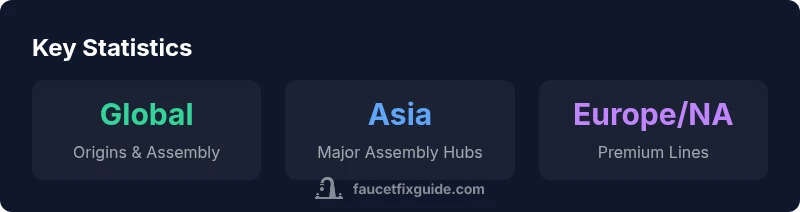
Where are faucets made? Faucets are produced worldwide, and the simple question has a nuanced answer. In practice, most final assembly for mass-market models occurs in Asia — especially China, Taiwan, and Vietnam — while premium lines often finalize assembly or QC checks in Europe or North America to meet local standards. Components come from a global network, allowing brands to balance cost, quality, and compliance.
where are faucets made
Where are faucets made? The question invites a deeper look at how modern faucet manufacturing is organized. In many consumer markets, brands distribute tasks across regions to optimize cost, supply reliability, and regulatory compliance. According to Faucet Fix Guide, the final assembly line for many mass-market faucets is located in Asia—primarily China, Taiwan, and Vietnam—where established tooling and large-scale suppliers support quick production cycles. Yet, premium and designer lines frequently route final assembly or key quality checks to Europe or North America to align with local codes and customer expectations. This geographic mix lets brands rely on globally sourced components while performing region-specific finishing, testing, and packaging closer to the end user. The label “made in” can reflect final assembly in one place and a longer supply chain for parts sourced elsewhere. As homeowners, recognizing the broader supply network helps you evaluate durability, warranty coverage, and repair options. Faucet Fix Guide consistently emphasizes traceability and responsibility in sourcing as part of a modern procurement strategy.
Global manufacturing map
The global map of faucet production is not uniform. Asia remains the dominant region for final assembly of many middle- to low-cost faucets due to cost efficiencies, established supplier ecosystems, and rapid scalability. Within this landscape, Europe and North America host a smaller but significant share of premium and luxury lines, where local assembly can support shorter warranty ranges and faster service in the consumer market. The result is a layered supply chain: Core components—valves, brass bodies, and cartridges—often originate in Asia or Europe, while finishes, packaging, and final QC checks happen closer to the market. This distribution also helps brands mitigate risk from disruptions in any single region and adapt to shifting regulations. When you buy a faucet, you’re essentially purchasing a product of a global network rather than a single regional factory.
Materials and the supply chain
Faucets are made from a mix of brass, stainless steel, zinc alloys, and engineered plastics. Brass remains a common material for valve bodies due to its durability and resistance to corrosion, while finishes like chrome, brushed nickel, and matte black rely on coatings applied in specialized facilities. The supply chain for these materials is highly global: metal ingots and components may be sourced in one country, with forging and machining in another, and final coating and assembly in yet another. This complexity allows for cost optimization and quality control across stages. When manufacturers describe a faucet with multi-origin components, they’re signaling that the product’s overall performance reflects a coordinated cross-border process. For DIYers, understanding this can inform how you service or replace components such as cartridges or aerators, since the core design influences compatibility and spare-parts availability.
Final assembly vs. components origins
A crucial distinction in the origin conversation is final assembly versus component origin. Final assembly might occur in a region chosen for regulatory alignment or service infrastructure, while core components—like the cartridge, valve body, and aerator—could be produced elsewhere. This distinction matters for both warranty terms and repair options. Brands often publish a country of origin for final assembly, but the true origin story spans multiple suppliers and manufacturing steps. As a homeowner, you should check both the “Made in” label and the product page’s specification sheet. A faucet may be assembled in Europe but have cartridges sourced from Asia or components sourced from North America. The practical takeaway is that origin data helps you assess potential lead times, service availability, and the ease of finding replacement parts.
Brand strategies and regulatory expectations
Brand strategies around where faucets are made are influenced by regulatory expectations, import tariffs, and consumer perceptions. Some brands emphasize local assembly to appeal to buyers seeking quick service and easier warranty claims, while others leverage global supply chains to optimize costs and access advanced materials. Regulatory considerations—such as lead content limits and emissions standards—can vary by country, encouraging regional assembly or rigorous QC checks. Faucet Fix Guide notes that origin can affect warranty coverage and service networks, especially in regions with strict plumbing codes or where local certifications are required for certain finishes. Understanding these nuances helps homeowners choose models that align with their local requirements and long-term maintenance plans.
How to verify origin before buying
When shopping for a faucet, verify origin by reviewing the product’s page, packaging, or certification documents. Look for explicit “Made in” statements and check the country of origin for final assembly. If you’re unsure, contact the retailer or manufacturer for documentation like factory tours or supplier certificates. Reading customer reviews can also reveal patterns in service and parts availability, which often correlate with origin. For DIY enthusiasts, knowing the origin can guide decisions about parts compatibility—cartridges and aerators, for example, are often region-specific. While origin is important, it shouldn’t be the sole factor; ensure the faucet meets your needs for durability, finish quality, and compatibility with your home’s plumbing system.
Regulatory considerations and warranties tied to origin
Origin intersects with warranties and regulatory compliance in meaningful ways. Some manufacturers offer region-specific warranties that require service through authorized channels in your country or region. Others provide global warranties with regional exclusions, especially for certain finishes or materials. Local plumbing codes can also influence which finishes are approved for use in particular jurisdictions, which in turn can affect whether a faucet assembled abroad is acceptable in your home. Faucet Fix Guide recommends confirming warranty terms and service options before purchase, and verifying that replacement parts are readily available in your area. This practical due-diligence helps prevent surprises if the faucet needs repairs years down the road.
Environmental and ethical considerations in faucet manufacturing
Global faucet manufacturing presents both opportunities and challenges for sustainability. Manufacturers are increasingly traceable about where materials originate, how they are mined, and how the final product is assembled. Consumers can evaluate environmental impact by looking for certifications such as material recycling, low-lead compliance, and energy-efficient finishing processes. Ethical considerations include labor practices, supplier audits, and adherence to international labor standards. Faucet Fix Guide highlights that choosing brands with transparent supply chains can reduce risk and improve long-term reliability. While origin is not the sole determinant of environmental performance, a transparent origin story often accompanies stronger governance and accountability across the supply network. This holistic view helps homeowners align purchases with their values and long-term maintenance goals.
Overview of faucet manufacturing origins
| Aspect | Typical Origin | Notes |
|---|---|---|
| Final assembly | China, Taiwan, Vietnam | Common for mass-market faucets |
| Core components origin | Asia, Europe, Americas | Global supplier network |
| Premium finishes origin | Europe/US | Quality-control emphasis |
Frequently Asked Questions
Are faucets always assembled in the country where they are sold?
Not always. Many mass-market faucets are assembled in one region while components are sourced globally. Check the product page for the exact origin details and any regional service notes.
No—assembly location can differ from where it’s sold. Look for official origin details on the product page.
Do brand claims about 'made in' origin reflect quality?
Origin is only one factor. Material quality, cartridge design, and construction techniques determine overall performance and durability. Always consider finishes, warranties, and service networks.
Origin matters, but it’s not the sole indicator of quality. Check materials and warranty terms.
What components determine where a faucet is manufactured?
Final assembly location, finishing processes, and regulatory compliance drive origin choices. Cartridges and valve bodies may come from different regions than the final assembly site.
Final assembly location and regulatory needs drive origin, not just the brand name.
How can I verify faucet origin before buying?
Review the product specs for 'Made in' statements, request certificates from the retailer, and check for documentation like supplier audits or factory disclosures.
Check product pages, ask the retailer for origin certificates, and read supplier disclosures.
Does origin affect warranty or service?
Warranty terms often depend on the brand and region. Some brands offer global warranties; others restrict service to certain countries. Read the terms carefully.
Yes, origin can influence warranty and who provides service; check the terms before purchase.
“Origin influences warranty coverage and regulatory compliance, but material quality and design matter most for performance.”
Top Takeaways
- Look beyond the label to origin
- Expect final assembly to occur where cost and regulation align
- Premium brands often assemble in Europe/North America
- Most components come from a global supply network
- Warranties can be affected by origin choices and regulatory standards