Is Tap Water Harder Than Bottled Water? A Practical Comparison
Explore whether tap water is harder than bottled water, how hardness is measured, and practical strategies for homeowners to manage mineral content and protect appliances.


Quick answer: is tap water harder than bottled water? It depends on where you live. Municipal taps can be soft, moderately hard, or very hard, depending on local geology and treatment. Bottled water often comes from similar sources and may be treated differently, so hardness can vary between brands. For most households, the practical difference centers on how hardness affects appliances, soap use, and taste rather than a blanket rule.
What does water hardness mean, and how is it measured?
Hardness in water refers to the concentration of dissolved minerals, primarily calcium and magnesium, which come from soil and rock as water travels through the ground. It is not a flavor, but a mineral load that can influence how soap lathers, how quickly minerals form scale in kettles and pipes, and how efficiently appliances operate. Utilities and bottlers typically report hardness in milligrams per liter (mg/L) as calcium carbonate (CaCO3), a standardized way to compare mineral content. Local reports vary by lab methods and regional geology, so readings can differ from one city to the next. For homeowners, the essential takeaway is to know whether your water is generally soft, moderately hard, or hard enough to cause scale in household fixtures. According to Faucet Fix Guide, hardness is largely driven by local geology and the way water is treated before reaching your faucet. This framing helps you interpret city reports and brand claims without assuming a universal standard.
Labeling and interpretation
- Soft water: low mineral content; usually easy soap lather and minimal scale
- Hard water: higher mineral content; more soap scum and potential scale buildup
- Moderately hard: mid-range conditions with noticeable but manageable effects
Because hardness can impact cleaning efficacy and appliance longevity, many households consider a simple treatment plan if they notice scale, extra soap usage, or mineral deposits. Faucet Fix Guide emphasizes using local water quality reports as your first reference point, then evaluating whether treatment is worth pursuing for your specific needs.
Comparison
| Feature | Tap Water | Bottled Water |
|---|---|---|
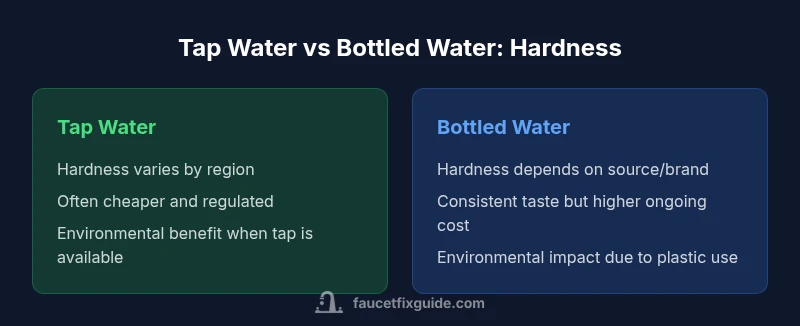
| Hardness (general concept) | Varies by source, often soft to hard depending on regional geology and treatment | Varies by brand and source; some bottles are softer, others harder depending on origin |
| Taste consistency | Can vary with source, storage, and plumbing; taste may change with season and pipes | Often designed for consistent taste within a brand, though mineral content varies by batch |
| Cost per liter | Typically cheaper at home given regular tap access and no packaging costs | Usually higher due to bottle, transport, and packaging costs |
| Environmental impact | Lower when tap water is readily available and treated locally | Higher due to plastic waste and transport emissions |
| Availability and convenience | Dependent on municipal delivery and infrastructure; constant at home | Requires purchasing and storage; convenience varies by retailer and location |
| Treatment options at home | Stronger emphasis on filtration for taste and mineral reduction; softeners are a consideration | Less need for at-home treatment unless brand-specific minerals are a concern |
The Good
- Low upfront cost when using tap water for everyday needs
- Regulated supply with consistent delivery to most homes
- Easier to implement home water tests and simple treatments
- Lower environmental impact compared with bottled water in many scenarios
What's Bad
- Hardness varies by region and season, making uniform results impossible
- Scale and soap efficiency can affect appliances and cleaning performance
- Taste and odor can vary with the source and plumbing, sometimes less predictable than bottled water
Tap water and bottled water each have pros and cons regarding hardness
There isn’t a universal rule. Check local water quality reports, weigh cost and environmental factors, and consider modest treatment if hardness affects your needs or appliances.
Frequently Asked Questions
Is water hardness the same everywhere in a city or region?
No. Water hardness varies by source, geology, and treatment. Municipal supplies can be soft in some districts and hard in others. Always check your local water quality report for region-specific guidance.
Hardness varies by your area. Check the local water quality report to understand your specific conditions.
Can bottled water be softer or harder than tap water?
Yes. Bottled water can differ in mineral content based on its source and treatment. Some brands are softer, others harder. Compare the label and source to gauge hardness relative to your tap water.
Bottled water varies by brand; some are softer or harder than your tap water. Check the label for the source.
What steps are most effective to reduce hardness at home?
Common methods include water softeners, certain filtration systems, and, for drinking water, reverse osmosis. Each method targets minerals differently, so choose based on whether you need laundry, cooking, or drinking water treated.
Water softeners and RO filtration are common options. Pick based on whether you need whole-house or drinking-water treatment.
What are the signs that water hardness is affecting appliances?
Frequent mineral buildup on kettles, showerheads, and fixtures, reduced soap efficiency, and visible scale in pipes or appliances can indicate noticeable hardness. Regular maintenance and testing help prevent damage.
Look for mineral buildup and reduced cleaning efficiency as signs of hard water.
Do I need a water softener or filter if my water is hard?
Not always. If hardness causes scale or soap inefficiency in your household, a softener or a targeted filter can help. Some households manage with routine cleaning and occasional testing, while others benefit from whole-home solutions.
A softener or filter helps if hard water causes issues; evaluate your home’s needs first.
How can I verify hardness without professional testing?
You can start with a consumer water hardness test kit or obtain your utility’s latest report. While not as precise as laboratory tests, these methods provide enough guidance to decide on basic treatments.
Try a home test kit and review your water report to gauge mineral content.
Top Takeaways
- Test your local water hardness before choosing a path
- Tap water is often economical and sustainable when readily available
- Bottled water offers consistency but at higher ongoing cost
- Consider simple at-home treatments to manage hardness if needed
- Choose based on your priorities: taste, cost, and equipment longevity