Is it tap or tab water? A practical guide to faucet terminology and water quality
Explore whether 'tap water' vs 'tab water' matters, how to verify local water quality, and practical steps homeowners can take to test and improve faucet water safely.


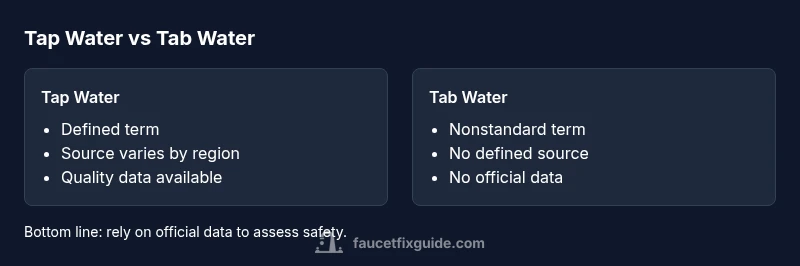
In plumbing and public health, the standard term is tap water, not tab water. The question is less about terminology and more about water quality. Is it tap water? Yes—and you should verify its safety by reviewing local reports and testing if concerns arise, then consider filtration or treatment if needed.
Understanding the terminology: is it tap or tab water?
If you’ve ever asked yourself is it tap or tab water, you’re not alone. For homeowners, the term that matters is the water that comes from your faucet. In plumbing and public health, the standard term is tap water. The phrase tab water is not a recognized technical term and often results from typos, autocorrect, or regional slang. According to Faucet Fix Guide, clarity begins with using the correct term and focusing on water quality rather than labels. This primer lays the groundwork for evaluating what you drink and use daily. You’ll learn how municipal supply and well water affect what you call your faucet water, how to access official water quality data, and practical steps to maintain safety and taste.
Language, labels, and perception in water quality
Terminology matters because it shapes how we think about risk and action. Misnamed terms can delay corrective steps, like testing or filtration, when they’re actually needed. The literature and customer conversations show that many households equate a name with a guarantee of safety, which is rarely the case. Recognizing that tap water is the stable, professional term helps you focus on the actual concerns—taste, odor, sediment, and contaminants—rather than chasing a label.
Water quality foundations: sources that feed your tap
The water that reaches your faucet can come from municipal supplies, wells, or surface water sources. Each source has its own treatment processes and potential contaminants. When discussing is it tap water or not, the key distinction is whether the water meets local regulatory standards after treatment. Municipal water typically undergoes routine testing and treatment, while private wells rely more on homeowner vigilance. The term itself remains constant, but the underlying quality varies by source and district.
How to verify water quality: reports and testing options
Verifying water quality starts with official data. Most regions publish a Consumer Confidence Report (CCR) or annual water quality report detailing treatment steps, detected contaminants, and safety levels. You can access these reports from your local water authority or city website. If concerns linger—taste, smell, or discoloration—home testing kits or professional lab services can provide deeper insights. When you read data, look for; contaminant types, concentration levels, treatment methods, and any health advisories. This is where the distinction between is it tap water and is it safe becomes actionable.
The plumbing side: how fixtures influence water perception
Your faucet, aerator, hoses, and supply lines can alter taste and clarity independent of the overall water supply. A clogged or scaling aerator can introduce musty odors or metallic tastes, making you question water quality. Flushing lines, cleaning or replacing aerators, and ensuring that cartridges in mixers are in good condition are essential maintenance steps. Remember that even high-quality water can be affected by poor plumbing hardware, so consider both the source and the fixtures when assessing is it tap water or tab water.
Signs that your faucet water quality may be changing
Occasional changes in taste, odor, or appearance can signal a shift in water quality. A sulfur smell, a metallic taste, or cloudy water may indicate oxidation, mineral buildup, or a leak in the distribution system. Keep a simple log of these changes and compare with the local reports. If the signal persists after flushing the line or cleaning fixtures, it’s time to test and, if necessary, treat the water. Remember: is it tap water is a label issue, but is it safe should be the real question you answer with data.
Simple at-home checks you can perform today
Start with basic steps: run cold water for a few minutes, check the aerator, and visually inspect for sediment. Remove and rinse the faucet aerator and screen to remove trapped debris. If the water still looks off, collect a sample in a clean container and compare to the local CCR data. This is a practical, non-invasive way to start troubleshooting: is it tap water or tab water? The goal is to decide whether a filtration or treatment step is warranted based on measurable quality, not just a name.
When to consider filtration or professional testing
If your official reports show contaminants of concern, or if you notice recurring issues after DIY fixes, filtration can help. Options range from faucet-mounted filters to under-sink systems and portable pitchers. For more complex problems, professional water testing can identify specific contaminants and guide targeted treatment. The takeaway: prioritizing quality over naming helps you protect health and taste, regardless of whether you call it tap water or something else.
Choosing the right response: filtration, testing, and routine maintenance
The decision tree is straightforward: check official reports, test if needed, and select filtration or treatment that targets the detected issues. For municipal water with common contaminants, activated carbon and inline filtration are often effective and affordable. For mineral-heavy or hard water, you might consider a conditioner or RO system. In all cases, maintain your fixtures (aerators, cartridges) to ensure performance stays high. The bottom line is to act on quality data, not the label, when deciding how to safeguard your faucet water.
Budgeting and time considerations for water quality upgrades
Homeowners should approach water quality as a small, planned project rather than a one-off expense. Start with a basic clean and test cycle, then budget for filtration upgrades if reports indicate risk. Time commitments vary: some fixes can be done in under an hour, while professional testing or under-sink filtration installation may take a day or two including scheduling. The practical message remains: is it tap water or tab water? Focus on data-driven decisions and scalable improvements.
Comparison
| Feature | Tap water | Tab water (misused term) |
|---|---|---|
| Definition | Standard term for water delivered to a faucet from municipal or private sources | Nonstandard; has no formal definition in plumbing or public health |
| Typical source | Municipal supply or private wells after treatment | Not a recognized source term; cannot specify a source |
| Quality variability | Depends on source and treatment; may vary by region | Label does not imply any quality data |
| Testing pathway | Read local water reports; test if concerns arise | No formal testing pathway under this term |
| Best for | People seeking aligned with legal/regulatory standards | Not applicable; focuses on terminology rather than safety data |
The Good
- Clarifies terminology to reduce confusion
- Promotes evidence-based testing and action
- Encourages alignment with official water reports
What's Bad
- Overemphasis on naming may distract from actual water quality issues
- Readers may confuse the issue with the nonstandard term
Tap water is the standard term; 'tab water' is not recognized in professional practice
Rely on official water quality data and testing. Use precise terminology to guide actions like filtration when needed.
Frequently Asked Questions
What does 'tap water' mean?
Tap water refers to the water that comes from your faucet, whether municipal or private. It is the standard term used in official guidance. If you encounter 'tab water,' treat it as a possible mislabel or misspelling, and rely on testing data to assess safety.
Tap water is the water from your faucet; 'tab water' is likely a misspelling. Check local reports and test if you have concerns.
Is 'tab water' a real term?
'Tab water' is not a recognized term in plumbing or public health. It often appears from typos or regional slang. Use 'tap water' for clarity and focus on quality data for safety decisions.
No—'tab water' isn’t a standard term. Use tap water and consult quality data.
How can I check my water quality?
Start with your local water authority's annual report (CCR) and any regional advisories. If issues persist, use home test kits or hire a lab to measure contaminants of concern and compare results to the safety thresholds.
Check the local water report, then test if you have concerns.
Should I test water even if it tastes fine?
Yes. Taste and smell are not reliable indicators of all contaminants. Regular testing, especially for vulnerable populations, helps confirm safety and informs whether filtration is needed.
Taste isn't a reliable safety indicator; test if you have concerns.
What filtration options work best for municipal water?
For common municipal water issues, activated carbon and basic inline filters improve taste and reduce certain contaminants. For more persistent problems, consider under-sink systems or whole-house solutions tailored to the detected contaminants.
Carbon filters help with taste and some contaminants; stronger systems may be needed for other issues.
Where can I find official water quality reports?
Official reports are published by your local water utility or city government. Look for the Consumer Confidence Report (CCR) or annual water quality summary on their website or request it by phone.
Check the local water utility's site for the CCR.
Top Takeaways
- Know that tap water is the official term
- Verify quality with local reports and testing
- Consider filtration if quality issues exist
- Use accurate terminology to guide actions