One vs Two-Handle Faucets: Which Is Best for Your Home?
Compare one-handle and two-handle faucets to decide which is better for your kitchen or bathroom, with guidance on operation, installation, cost, maintenance, and long-term value.


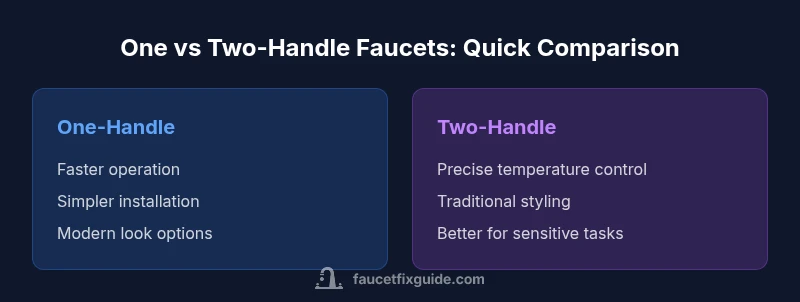
When deciding which is better one or two handle faucets, consider ease of use, installation, and temperature control. One-handle models simplify operation and typically install faster, while two-handle faucets offer precise hot/cold mixing and a classic look. Choose one-handle for simplicity and modern aesthetics; choose two-handle for precise control and traditional styling.
Why this comparison matters for homeowners
Choosing between one-handle and two-handle faucets affects daily use, maintenance, and even remodel budgets. In this long-form guide, we address which is better one or two handle faucets for kitchens and bathrooms, and how your choice influences comfort, accessibility, and longevity. According to Faucet Fix Guide, handle design can influence reach, grip, and response time, especially in high-use areas or households with limited dexterity. The Faucet Fix Guide team found that most homeowners prioritize two factors: ease of operation and the ability to control water temperature with confidence. This section lays the groundwork by outlining how each configuration works, what trade-offs you should expect, and how to evaluate your existing plumbing and sink setup. By the end, you’ll have a clearer framework for deciding which option fits your space, budget, and goals.
How one-handle and two-handle faucets operate
One-handle faucets use a single lever or knob to mix hot and cold water. The lever position determines temperature and flow, and most models use a ceramic disc cartridge for reliability. Two-handle faucets use separate hot and cold knobs; the temperature is adjusted by balancing the two flows. Both designs can use common cartridge mechanisms, but the number of seals and o-rings varies with configuration. In practice, one-handle models typically offer faster adjustments, while two-handle models provide slower, more granular control, especially useful for families with varying sensitivities to heat. When choosing, consider whether you prefer the simplicity of a single motion or the precise pairing of two controls. The newer materials and finishes do not change the fundamental operation, but they do affect maintenance needs and replacement availability.
Which is better one or two handle faucets?
The answer depends on your priorities and space, but several core truths hold across kitchens and bathrooms. One-handle models excel in small spaces and busy households where speed matters, since you can adjust temperature with a single motion. Two-handle designs shine when precise temperature control is essential or when you prefer a timeless, traditional aesthetic. From a plumbing perspective, both configurations rely on similar cartridge technologies, but the number of moving parts differs. Because of that, fail points can shift: fewer moving parts in a one-handle arrangement can translate to quicker repairs, while more components in a two-handle setup can complicate service but deliver finer control. Therefore, the best choice balances user needs, sink configuration, and your willingness to maintain additional components.
Design and space considerations
Space on the countertop and clearance around the faucet handle are major factors. One-handle faucets typically require less vertical and horizontal space, which makes them appealing for tight sinks, compact kitchens, or powder bathrooms. Two-handle models often have taller stems and broader profiles, which can interfere with under-sink pipes or soap dispensers. When you plan a remodel, map your sink’s hole configuration, deck thickness, and clearance to ensure the chosen faucet will fit without crowding existing hardware. If you frequently service the faucet from above the sink, measure the reach of the handle to avoid hitting the backsplash or cabinet doors. Finally, consider accessibility and ergonomics: a lever that’s easy to reach and operate should be prioritized, especially for children, seniors, and people with limited dexterity.
Installation and maintenance differences
From an installation perspective, one-handle faucets generally require fewer connections and parts, translating to a quicker install for a DIY homeowner and less risk of leaks during assembly. Two-handle faucets involve separate hot and cold supply lines and more seals, which can extend installation time and introduce more potential leak points if not aligned properly. In terms of maintenance, both configurations rely on cartridge seals; the difference is that two-handle models may require care for two cartridges, increasing the potential for wear and replacement frequencies. Over time, the choice can influence maintenance cadence: easier-to-service designs tend to save time on re-sealing tasks and cartridge replacements, while more complex two-handle assemblies can offer longer intervals between maintenance if built with quality components.
Cost, price ranges, and value
Cost is a common deciding factor. One-handle faucets often come in a wide price range, with basic models starting lower but premium finishes and brands still available. Two-handle faucets can be similar in price, but some finishes or traditional-styled models may push the price higher due to valve assembly complexity and styling premium. When budgeting, consider not just the faucet but also required accessories such as deck plates, mounting hardware, and supply lines. Additionally, compare replacement cartridge prices and availability; even with two handles, compatibility across brands can vary, affecting long-term value. In a remodeling context, you’ll also weigh installation costs, whether you hire a plumber or do it yourself, and whether the faucet’s warranty covers labor.
Durability and reliability
Durability for either configuration hinges on build quality, cartridge design, and finish. Ceramic disc cartridges are common in both one-handle and two-handle models, and better-quality versions resist mineral buildup and leaking. The number of moving parts correlates with potential wear: one-handle systems may have fewer seal points, while two-handle systems can isolate wear to individual hot or cold sides. In terms of reliability, stainless or advanced finishes resist corrosion; popular finishes like chrome, brushed nickel, and matte black each have pros and cons related to cleaning and spotting. From Faucet Fix Guide’s perspective, durability is best when you select reputable brands, ensure proper installation, and perform periodic cartridge checks. Regular maintenance—like cleaning aerators and wiping down lever mechanisms—extends life and reduces the risk of leaks.
Style and finishes
Design aesthetics matter for most remodels. One-handle faucets tend to align with contemporary, minimalist interiors and can be chosen in a wide array of finishes. Two-handle fixtures evoke a traditional or transitional bathroom or kitchen look and are frequently paired with classic hardware and cabinetry. Finishes vary by brand and might include chrome, brushed nickel, matte black, and oil-rubbed bronze; many homeowners select a finish that matches sinks, cabinetry, and lighting. Regardless of handle count, choose a finish that hides water spots and fingerprints in the spaces where your faucet is installed. Also consider clearance for the handles in high-traffic zones; a lever that can move smoothly without snagging on a sink edge improves daily convenience.
In-kitchen vs bathroom scenarios
Kitchen environments emphasize toughness, ease of cleaning, and reach across a wide basin, while bathrooms prioritize precise water control and splash minimization. One-handle faucets work well in dense kitchens where you need to turn on water with one hand while loading a dishwasher or washing produce. Two-handle models suit bathroom sinks where precise temperature control matters for shaving, baby baths, or children washing hands. If your family has a mix of heights, chore patterns, or mobility limitations, you may lean toward one configuration and select a model with ergonomic handles. In short, assume that kitchen conditions tilt toward simplicity and ease of use, whereas bathrooms may benefit from the precision of dual control.
Choosing based on needs
Weigh your top priorities: speed of access, temperature precision, and the level of maintenance you’re comfortable with. If you cook daily and want to minimize complexity, one-handle is often the better starting point. If you value precise temperature control for sensitive tasks or prefer a traditional look, two-handle models deserve serious consideration. Assess your sink configuration, the space behind the faucet, and whether an optional deck plate will be necessary. Compare at least two or three models in your price range, paying attention to cartridge type, finish durability, and installation requirements. Finally, review warranty terms and service availability in your area; a well-supported brand reduces risk and gives you peace of mind.
Retrofits and compatibility checks
Before purchasing a new faucet, verify compatibility with your sink and countertop: hole configurations, mounting hardware, and supply line connections must align with the new model. If you have an older home or non-standard centers, you may need adapters or a new deck plate to bridge gaps. Check the faucet’s warranty and whether replacement cartridges are readily available from local retailers or online, as this influences long-term maintenance. If you’re replacing a single-handle with a two-handle model, or vice versa, you may need to re-plumb or adjust supply lines. With careful measurement and planning, most households can update faucet handles without major renovations.
Quick-start checklist before purchase
Use this quick-start checklist to compare options: confirm sink hole configuration, verify center-to-center measurements, review cartridge type and replacement availability, assess handle comfort and reach, evaluate finish durability and maintenance, and confirm warranty terms. Rank your priorities on ease of use, temperature control, installation time, and aesthetics, then read customer reviews for real-world reliability. Finally, test movement and grip in a showroom or with a home demo, ensuring the faucet feels natural when you wash hands or fill a pot.
Comparison
| Feature | One-handle faucet | Two-handle faucet |
|---|---|---|
| Operation and control | Single lever controls both water flow and mix | Separate hot and cold controls offer precise mixing |
| Installation complexity | Fewer parts and connections, typically quicker install | More parts and lines, longer install |
| Maintenance & parts | Often simpler with fewer cartridges | Two cartridges and more seals, potential more maintenance |
| Best for | Small spaces, fast operation, streamlined look | Traditional styling, precise temperature control |
| Price range | Often broad range with many budget options | Can be similar or higher depending on finish and brand |
The Good
- Simpler operation and installation for one-handle
- Fewer potential leak points with fewer cartridges
- Wide selection of budget and premium finishes
- Two-handle models offer precise temperature control and classic style
What's Bad
- One-handle may lack fine temperature adjustment for sensitive tasks
- Two-handle setups can be bulkier and take longer to install
- Replacement parts vary by brand and may affect long-term cost
Two-handle faucets balance precision and classic style, while one-handle options win on ease of use and install simplicity.
Choose two-handle for exact temperature control and traditional look; opt for one-handle when speed, simplicity, and compactness matter more.
Frequently Asked Questions
Which is more durable, one-handle or two-handle faucets?
Durability depends on build quality, cartridge design, and maintenance rather than handle count. Both configurations can last a long time if you choose reputable brands and perform regular upkeep.
Durability depends on quality and care, not the number of handles.
Are one-handle faucets easier to install than two-handle models?
Yes, in many cases one-handle models have fewer parts and supply connections, which can simplify installation and reduce leak risks if installed carefully.
One-handle models are usually easier to install due to fewer parts.
Do two-handle faucets save water or are they simply for control?
Two-handle faucets do not inherently save water; the potential is in precise control and user behavior. Either configuration can be efficient with proper aerators and good habits.
Water savings depend on use habits and aerators, not only handle count.
Can I convert a single-handle faucet to a two-handle setup?
Conversions are possible in some cases but require compatible sink configurations and new valve assemblies. Often replacing with a matching two-handle model is simpler and more reliable.
Converting can be tricky; replacing with a matching model is usually easier.
What factors should drive my choice for a bathroom renovation?
Focus on ergonomic access, water temperature needs, and overall style. If accessibility matters, one-handle can be friendlier; if you prefer traditional styling or precise control, two-handle is better.
Think about accessibility and style when renovating.
Is maintenance easier with one-handle or two-handle faucets?
Maintenance ease depends on the model and brand. Some one-handle designs are simpler to service, while well-made two-handle units can isolate wear on one side.
Maintenance depends on the model; either can be easy with good parts.
Top Takeaways
- Evaluate daily tasks to prioritize control vs. simplicity
- One-handle is generally easier to install and use
- Two-handle delivers precise temperature control and classic aesthetics
- Check sink configuration and space before buying
- Prioritize cartridge availability and warranty